
On Bourdain
Three pieces from the archive

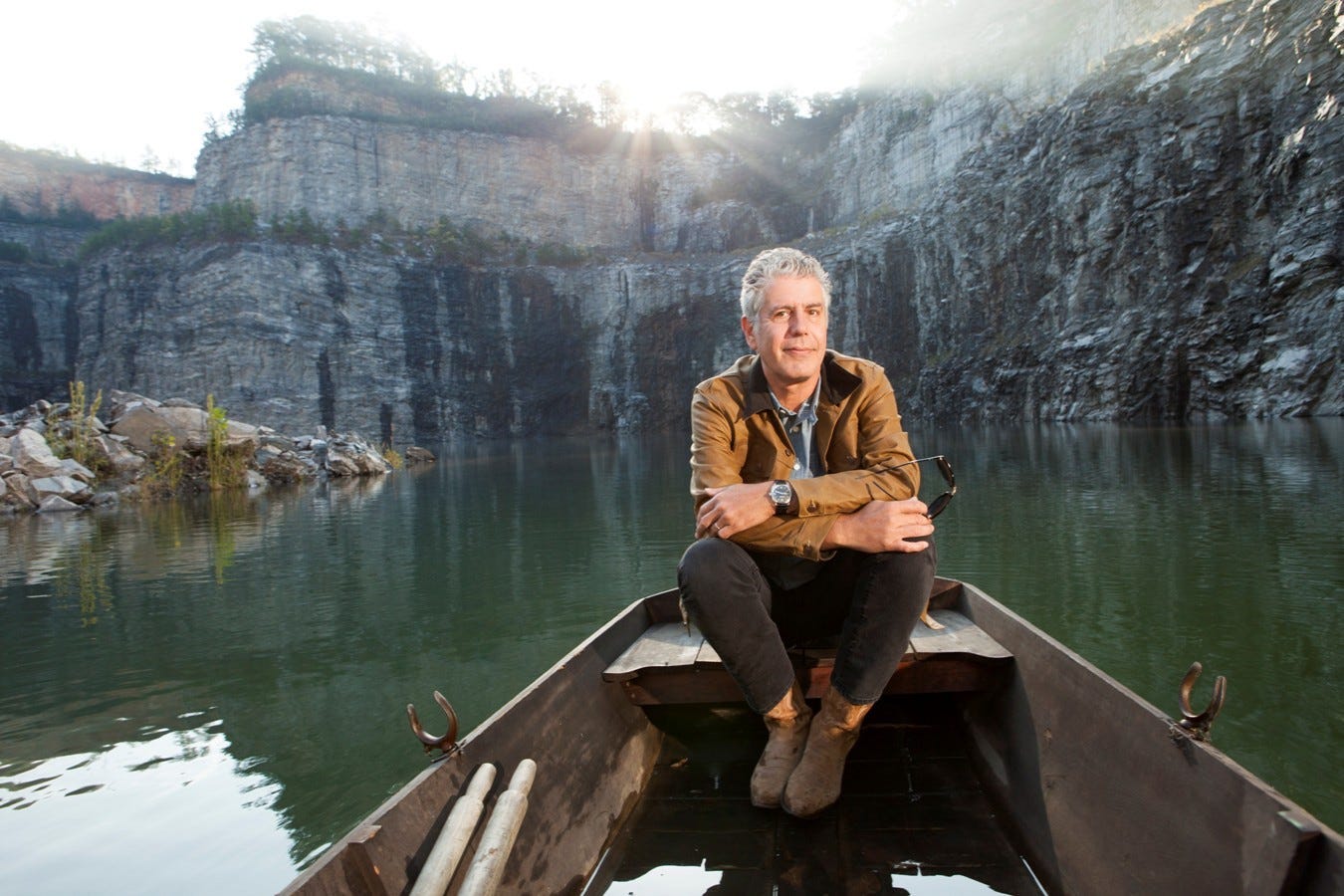
I recently read Cailey Rizzo’s excellent piece about meeting Anthony Bourdain and was inspired to republish my unofficial trilogy of articles about him. The first was published on the website of The Monthly in December 2017, the second on Medium in the wake of his death in June 2018, and the third, my review of Morgan Neville’s Roadrunner: A Film About Anthony Bourdain, on the website of The Monthly in November of 2021. They have been lightly edited, but not for content, with the result that there is some duplication between them. On the other hand, because I have not massaged my views, you should be able to see how, over time, I gradually began to question some of them.
The anti-foodie foodie
Did anyone see it coming? Did Anthony Bourdain himself? How did a man who made his name with a book that largely glamourised the swinging-dick bro culture of professional kitchens—a book whose cover showed him and a couple of other dudes wielding long, sharp, rather phallic-looking knives—come to be a much sought-after interview subject on everything from the Trump presidency to the Weinstein scandal? How did he come to be treated as a public intellectual?
At least part of the answer is that Bourdain has always been a smarter, more moral and self-interrogating individual than he’s been given credit for. It’s simply taken us a while—too long, really, given the evidence of his work—to notice. This is partly down to who the man is, or presents himself as, in his work: rakish, devil-may-care, cool. He swears, he drinks, he smokes. (He also churns out work at a rate that no real hard-living alcoholic could match, which should have tipped us off.)
But the number of people who read Kitchen Confidential and still somehow manage to persuade themselves that it’s a paean to curse words and being a jerk is finally beginning to dwindle. Any serious engagement with Bourdain’s output—including Kitchen Confidential, which actually condemns the lifestyle it describes, however subtly—leaves one wondering how that number could have been so high in the first place.
The evidence has been piling up for a while, of course. Bourdain’s first television series, A Cook’s Tour on the Food Network, was basically what it said on the label. (You can catch that series on Netflix, and it’s a fascinating document about being a middle-aged career cook whose book has become an unexpected bestseller.) But in the series that followed it—No Reservations on the Travel Channel and Parts Unknown, the tenth season of which just finished airing on CNN—Bourdain’s desire to do something more important than simply service the bourgeois-bohemian predilection for food porn was immediately apparent. (The only other celebrity chef whose work comes close is Jamie Oliver, who clearly believes he has a social mission. We’ll come back to the others, who essentially amount to corporate mouthpieces, in a moment.) Travel broke something in Bourdain. Or, perhaps, fixed it.
No Reservations, repeats of which are constantly airing on SBS Food, was always a more serious affair than A Cook’s Tour. But we can nevertheless point to its most famous episode, ‘Beirut’, as the point where Bourdain really stopped producing a particularly well-made but otherwise stock-standard food-and-travel program and started making a kind of high-minded news program disguised as a stock-standard food-and-travel one. Other episodes in its vein soon followed.
One always hopes to catch one of these episodes when flicking through the channels: the episodes that abandon food entirely in favour of reporting the news of the day, or dealing with history, or both. In the Beirut episode, which went on to win a Peabody Award, the 2006 Israel–Hezbollah War breaks out, cutting short the shoot and forcing the host and his crew to evacuate. (The episode is unremittingly depressing. Bourdain has said that he was adamant there not be “any corny element of hope there at the end. You know, we’re all going to end up ground under the wheel.”)
I would also point to No Reservation’s Laos and Haiti episodes, the first of which is primarily occupied with the ongoing matter of unexploded ordnance that has bedevilled Laos since the end of the United States’ secret bombing of the country throughout the Vietnam War (Bourdain almost can’t bring himself to eat the meals offered by the dirt-poor people doing the cooking, wanting only to apologise for his country’s actions) and the latter of which unintentionally finds itself tackling, in the wake of the 2010 earthquake, the fraught morality of international aid. (It does so in spectacular miniature: Bourdain buys out a street vendor, telling her to serve the kids who have been eyeing him eating at her stall, with the result that a massive line forms and fights break out.)
Parts Unknown has been even bolder in its commitment to current affairs. Season three’s ‘Russia’, shot in the lead-up to the Sochi Winter Olympics, reveals perhaps more than any other where Bourdain’s interests increasingly lie. He meets Boris Nemtsov, the liberal leader who was murdered the following year, and Alexander Lebedev, the publisher of Novaya Gazeta, the famous independent newspaper where Anna Politkovskaya made her name before being gunned down in her apartment building in 2006. There are shots of the food coming out—and shots of the shots you inevitably wind up drinking in Russia—but very little discussion about it once it’s on the table (though there’s a little bit about Lebedev’s potato-farming interests). It’s an episode almost exclusively dedicated to Russian politics under Putin, and Bourdain has no reservations (I’m so sorry) about telling us what he thinks. One might also point to the harrowing episode about Massachusetts, in which Bourdain visits the kitchens in which he first started cooking and the alley in which he first bought heroin. Talking to doctors, narcotics officers, kitchen-sink drug dealers, and a support group for former prescription drug-turned-smack addicts, he puts together one of the best hours on America’s opioid epidemic you’re likely to see. The episode ends—it’s a food show, right?—with a clam bake.
Obviously, food continues to feature prominently in Bourdain’s television work, and his latest literary offering, Appetites, is a cookbook. In an excellent review of Appetites for Canada’s Globe and Mail—I defy you to name anyone else on the planet who could command space in the literary pages with a cookbook—Jen Agg noted that even here there’s a subtle political element to what’s going on. “He’s reaching into the subconscious of middle- and lower-class America to pull out these recipes,” Agg writes. “But this is also the same Anthony Bourdain who is one of the most well travelled people on the planet, so the overwhelming majority of his comfort food recipes are from far-flung places such as Kuala Lumpur and Budapest […] This subtle drawing of similarities between American and ‘foreign’ food is, to me, the best thing about this book—not that the flavours are the same, but that the feelings comfort foods evoke in people are.”
It’s a good observation, if not a great sentence, because it recognises the key thing about Bourdain’s work: the fact that, because food is really about people, food is itself, by definition, political. Indeed, Bourdain recently narrated a film about food waste, Wasted!, which is available online. “I don’t like the idea of being an advocate,” he said in an interview about the documentary. “But this is an area, this is an issue, that goes fundamentally against my instincts as a long-time working cook and chef.”
The structure of his television work remains as simple and straightforward as his prose: Bourdain visits a place, tracks down a local fixer or chef or cab driver (or, in Hanoi, Barack Obama), and chows down for the next forty minutes or so. But the manner in which he does so—indiscriminately—is entirely at odds with the approaches taken by every other celebrity foodie you could name. Bourdain means it when he says that food is for everyone and isn’t that important anyway. (There’s a reason he gives craft beer a hard time and claims not to give a shit about wine.)
This isn’t an argument being made by any other food show on the market. It certainly isn’t an argument being made by any of the food magazines on our supermarket shelves. Early last year, despite my better judgement (and theirs, as it turned out), I found myself working for a “premium” food magazine. Its primary goal was to be that most horrid of things: an aspirational title.
There’s nothing wrong with aspiring to something, of course. But when the thing that one is aspiring towards is the ability to make mango tiramisu or deconstructed lamington, or to whip a superfood-based smoothie, on the basis of the pretty pictures in a magazine sponsored by a major supermarket chain…well, that’s a little different.
Last year, accredited dietitian Melanie McGrice told the Herald Sun that a growing number of Australians were falling victim to “food fad peer pressure”, particularly when it came to so-called superfoods, including many people who couldn’t afford to.
“I’ve seen people who can’t afford basic fruit and vegetables spending unnecessarily on things like coconut water because they feel pressure to purchase,” she said.
I put together a rewrite of this piece—it was my job to regurgitate others’ work with a bit of snark thrown in for flavour—realising as I did so that the result would never see the light of day. How to report the news of the moment without acknowledging that all our previous articles about kale and goji berries and gluten-free diets were in fact bullshit designed to make people buy shit? I tacked on a half-hearted ending about how we tried to make all our recipes healthy and cheap. But my suspicions proved correct: the article was never published. The last thing we wanted to do was point out the inherent classism of what we were doing.
Bourdain has no time for this sort of thing, and doesn’t believe that you should, either. For every fine-dining establishment he features on his shows—and he admittedly visits some of the best in the world—he features ten or more no-name street vendors you wouldn’t be able to find if you tried to.
The ‘Istanbul’ episode of No Reservations is a good example of this, though you can pretty easily find the döner place he eats at. He later accepts an invitation to dine with his fixer and her family. The family in question was no doubt vetted in order that this could happen, but he still calls the breakfast they enjoy together the best he’s had in town. I don’t doubt it.
Or consider his excellent episode in the American south-west with Josh Homme of Queens of the Stone Age, in which the pair visits crappy diners, eats a bunch of greasy hangover food, and then cooks a basic pasta at the Rancho de la Luna recording studio in Joshua Tree, California. Or, perhaps most relevantly, consider the “how-to” episodes in which well-known chefs demonstrate how to make basic dishes that don’t require much time, money, or effort. (A few more detailed recipes aside, Appetites takes the same approach.) There’s not a superfood in any of these dishes. There’s not a superfood in any of these episodes. It’s also telling that, no matter where Bourdain happens to find himself, he drinks the local beer without complaint, however tasteless, and has a great time.
This is more important than it sounds. In an age in which food and the ability to pay for it—not to enjoy it, necessarily, but to tell people later that you ate it—has become a kind of whack social currency, Bourdain has fashioned himself as the anti-foodie foodie, the guy who insists that food can be enjoyed by anyone, anywhere, at any time and at any pricepoint. He wants his viewers to aspire, but only to their own enjoyment. The rest of the culinary-industrial complex, in striking contrast, doesn’t. Its sponsors don’t make money that way.
The gradual but undeniable shift in the content of Bourdain’s work—if not its tone, which remains an appealing mix of irreverence, moral seriousness, and occasionally a little cheesy wistfulness—has no doubt contributed to his appeal to journalists as a go-to cultural commentator. As has his willingness to talk on the record without taking any prisoners (and, I suspect, the fact that he has the imprimatur of CNN behind him).
Last December, Eater ran a long-form interview with Bourdain about the election of Donald Trump. We can probably now see it as the point at which his persona began to undergo its most radical change, at least as far as the wider public’s perception of it is concerned. (There was little in the interview, in terms of what he said or how he said it, that followers of his work and the shifts in it would consider especially new.)
“I think to mock constantly, as so much of the left has done—to demonise, to ridicule, to treat with abject contempt people who live in a very different America than they live in—is both ugly and counterproductive,” he said, pointing out that he’s travelled through that “very different America” enough times to know that, well, some really nice people live there, and are just trying to get on with their lives. He also said, recalling his comments about not wanting to be an advocate, that “I have really no—zero, I don’t feel that I have any—responsibility.”
But that was then. In the past two months, Bourdain has become one of the most unequivocally outspoken male commentators, famous or otherwise, to have weighed in on the allegations against Harvey Weinstein. This is in part because Bourdain’s partner, the Italian actor and filmmaker Asia Argento, is one of the women who has gone on the record to level such allegations at the disgraced mogul. It’s also because the Weinstein affair has inspired women in the restaurant business to stand up and call out institutionalised sexism in their own industry. (It’s also because Bourdain is a good person.) In late October, New Orleans chef John Besh, who has appeared in Bourdain’s television work, was forced to step down from the group of restaurants he owns after the Times-Picayune reported allegations that Besh’s company ignored sexual harassment claims and that Besh himself had engaged in harassment himself. Bourdain had already been going after Weinstein and his enablers on Twitter with a ferocity unusual even for him. Now the world he grew up in—the world he wrote about in the book that made him famous—was under fire, too.
His response has been a masterclass in how to own up to something. Not for Bourdain the equivocations of your Matt Damons and Ben Afflecks. In an extended interview with Slate, Bourdain put it this way: “I’ve had to ask myself, and I have been for some time, ‘To what extent in [Kitchen Confidential] did I provide validation to meatheads?’
“[T]he system itself, from the very beginning, was abusive, was male-dominated and cruel beyond imagining […] [The Besh affair] is an indictment of the system.”
This reminded me of a line from Michael Herr’s Dispatches, the late journalist’s excellent book about the Vietnam War: “You were as responsible for everything you saw as you were for everything you did.” I’d eat my shoe if Bourdain hasn’t read that line and let it linger a little. His work has always suggested it, and continues to suggest it now, despite his comments deriding responsibility—a position that, in any case, is beginning to fall away.

The vein of our common humanity
I took a walk through this beautiful world /
Felt the cool rain on my shoulder /
Found something good in this beautiful world /
I felt the rain getting colder…
— Parts Unknown theme song, Queens of the Stone Age
In 2007, around the time I started getting interested in food and wine and began writing the occasional restaurant review, I read Anthony Bourdain’s Kitchen Confidential. A decade and change later, I don’t remember much about the book, aside from its whirling-dervish energy. But I do know that it made me want to become a cook. For several months—it’s almost hard to believe now—I seriously considered enrolling in culinary school. This was the kind of effect Bourdain had: he could make even twelve hours cutting onions sound sexy.
As it happened, I wound up becoming more like him than I would have done had I wound up on the line. In 2010—eight years ago this month—I left the newspaper where I was then working to strike out on the road. Bourdain had already been on it for years, and would remain on it for seven more, though I’d not followed his work very closely after committing myself to ink and newsprint. In 2016, when I returned to Sydney, and wound up working for a food magazine, I began to watch reruns of No Reservations on television and was surprised to find that it wasn’t a food show at all. It was something much more interesting than that.
There were certainly differences to our approaches. I travel overland, inching forward by degrees, where Bourdain spent more time in airports than was perhaps entirely healthy. In a 2016 episode of Parts Unknown, he told an Argentinian psychotherapist that a poorly made airport hamburger could send him into a “a spiral of depression that can last for days”. In an interview with NPR the same year, which aired again yesterday, he told Fresh Air’s Dave Davies that the nadir of all possible culinary experiences was an airport Johnny Rockets. We forget, because of the colour and movement of the shows, that he lived an existence not entirely dissimilar to that of George Clooney’s character in Up in the Air.
But the similarities were so much greater: the desire to keep moving, to hear people’s stories, to get beyond the spin and the stereotypes and see for oneself what was going on in the world. All this was hugely inspiring to me—it proved, at a time when I was back in a dead-end job, that such work could be done—and, as the reaction to his death online attests, to countless others as well. It also became, despite Bourdain’s tendency to play down the social or political value of his work, something of a mission, even an agenda. After his award-winning 2006 episode ‘Beirut’, Bourdain’s work became increasingly political. Human rights, the legacy of war, historical culpability, the opioid crisis: everything, it seemed, was on the table. (Everything, some critics grumbled, except food.)
This shift in his work, and in the public’s perception of it, was only exacerbated by the politics of the day. In the eighteen months or so before his death, Bourdain seemed to be everywhere, with the election of Donald Trump, the Weinstein scandal, and the rise of the #MeToo movement turning him into something of a catch-all cultural commentator. I wrote about this for The Monthly last December in a piece that is now being passed around online as something of a preemptive obituary.
It is an entirely selfish, but perhaps natural, thing to feel disappointed that I never met Anthony Bourdain. It’s a feeling I’ve had only a few times in the past: when George Harrison died, for example, and more recently when Robert Hughes passed away. Of course, it’s unlikely I would have ever met the Beatle, but Hughes was a distinct possibility. One of the perks of this profession is that one occasionally gets to meet one’s heroes. I’m not sure that’s how I would describe Bourdain, but he was definitely a fellow traveller, in both senses of the term, as well as someone whose work had become increasingly important to me as a model and ideal. Not only did I think it likely that I would get to meet him, I actually thought that day would come sooner rather than later. As I told an editor of mine yesterday, in a particularly pathetic flap of self-pity: “I was really hoping he’d read my novel and be like, ‘This is great. I love Vietnam. Let me blurb it and let’s be friends.’”
They say you shouldn’t meet your heroes, but I’ve always rather enjoyed meeting mine, even when it hasn’t gone swimmingly. In 2009, on separate occasions, I interviewed Christopher Hitchens and Clive James, two of the three great influences on my early writing. (Hughes was the third.) The first experience was everything I could have hoped for—we later went out to dinner in Sydney’s Chinatown and drank until four in the morning—and the second, well, not so much. (That’s a story for another day.) I was gutted when Hitchens died in 2011, and saddened, too, by the news of James’s illnesses, though he is of course still kicking. But my feelings in both cases were tempered by the fact that I’d been able to meet them, and, though it probably meant little to either, had told them what their work meant to me.
I can only imagine what meeting Bourdain would have been like. There have been countless moving stories on Twitter about his kindness and generosity. But there’s also the story, shared with me by a friend who met him while he was shooting in Antarctica, about the two weeks he spent at McMurdo Station: how his mood changed when the cameras weren’t rolling, the way he ate by himself, away from the crew, what my friend described as his melancholia. Who knows? There is something perverse, though again only natural, about looking for reasons—for explanations—in the wake of a man’s suicide, and something less than useless about wondering whether he would given me the time of day had we met. But at least I would have been able to tell him how much his work meant and mattered to me. Again, rather selfish, in its way—although, given the nature of his passing, perhaps not. Write your favourite author that letter.
As it is, the best way I have of honouring Bourdain’s memory is to keep doing my work, to keep tapping the vein he so marvellously tapped: the vein of our common humanity. Such work, as Martha Gellhorn once put it, is “the only thing I know absolutely and irrevocably to be good in itself.” There are not enough people doing such work, in part because, Bourdain’s example aside, it’s a terrible way to make a living and an excellent way to get shot. That Bourdain managed it, working in and subverting a genre whose output is mostly vacuous, most recently on a network that is as guilty as any other of peddling stereotypes and simplifications, is nothing short of miraculous. That he became famous for doing so—for exposing viewers, many for the first time, to stories that complicated their assumptions about Iran, say, or sub-Saharan Africa—is equally so, and one of the reasons his death stings so keenly.
It is difficult to get such stories, with their platitude-defying complexity, into print or on air at the best of times, and the people who write and produce them are often doing so on their own dime and time, at great personal and financial risk, simply because they believe in them. I can think of a few, but you probably won’t know them: Joseph Furey, Michael J. Totten, Clair MacDougall, Matthew Thompson.
The hole Bourdain leaves is too large and immediate for any of us, alone or together, to fill. He was the last of a certain kind of gonzo reporter: someone who combined style, substance and moral seriousness and had the resources—the institutional backing—to get that work seen by a sizeable audience, which was, as the tributes again make plain, markedly changed by the experience. The media landscape today, in the wake of his death, resembles the site of some meteoric impact, so sudden, so irreversible, so devastating. The crater still smouldering, and impossibly vast, we can point to it and say: that’s where he stood.
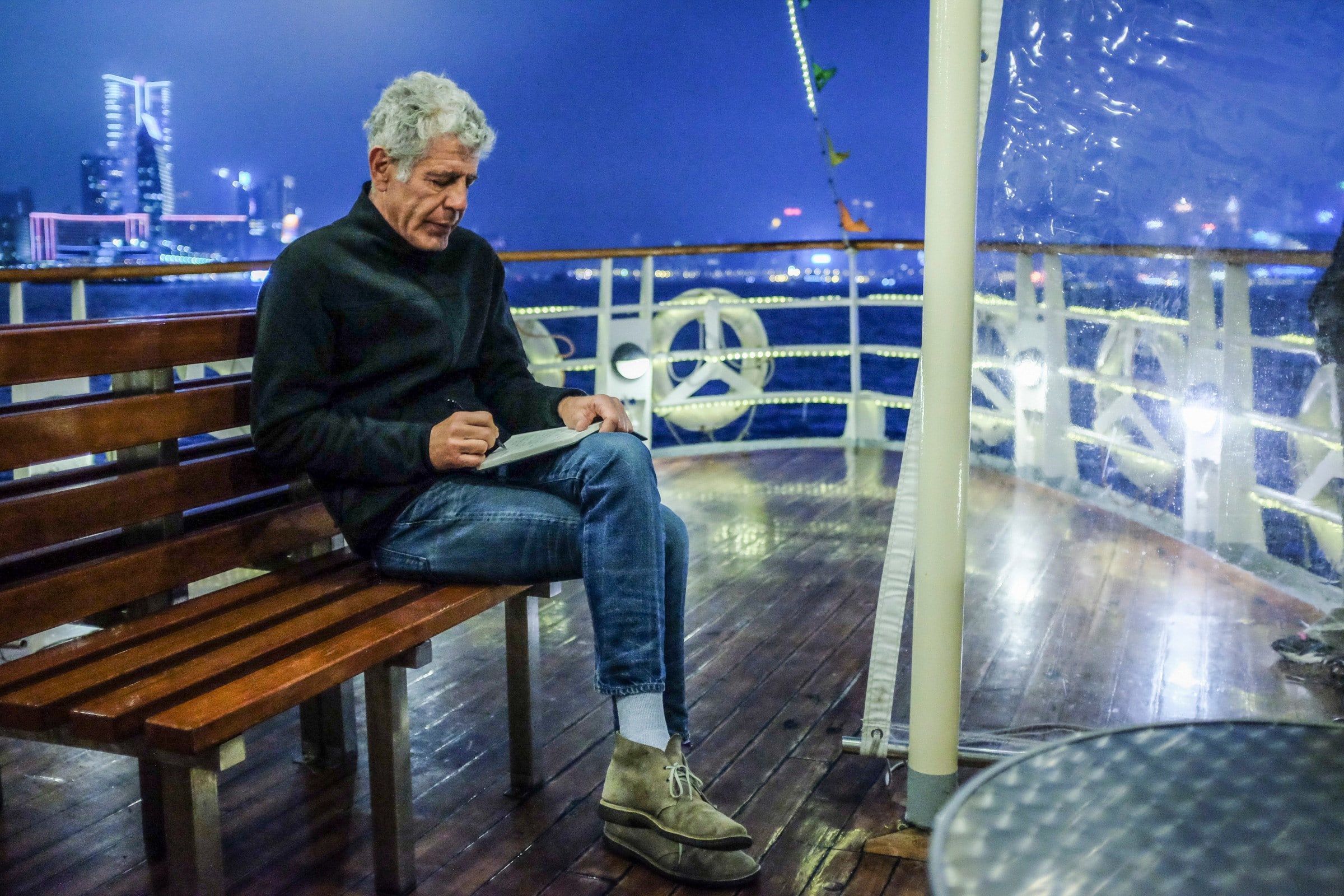
End of the road
I was always going to like Morgan Neville’s Roadrunner: A Film About Anthony Bourdain. I was predisposed to like it. Anyone who devoured Bourdain’s work, and who still hasn’t quite gotten over his 2018 death, was predisposed to like it. It was made for them.
The outpouring of grief that followed Bourdain’s passing, though not, perhaps, unique in its intensity, has proven unique in its longevity, in the way it has failed to dissipate. One suspects this has something to do with the manner of his death, and the fact that it still seems not to square with his life as it was popularly understood and portrayed on screen.
Putting aside the obvious fallacy contained in this assumption—that Bourdain’s on-screen portrayal was anything more than a glossy entertainment product and somehow precluded things ending this way—it remains true that, at the time, his suicide seemed incomprehensible. In the years since, as people have gone back to the books and the television work, to the interviews and Instagram stories, that incomprehensibility has come to seem short-sighted, a failure of close reading. The darkness was always on full display. Nevertheless, the wound has failed to heal.
Roadrunner, which was released in US theatres in July and is now in selected Australian cinemas, does not come anywhere close to healing it. Lack of resolution or explanation is not only appropriate in this case—though the film makes a few tilts at the latter—but seems only fitting given the grey area in which Bourdain’s best work operated. As one of his producers, Christopher Collins, notes in his discussion about the award-winning ‘Beirut’ episode of No Reservations, ambiguity was something the man embraced. But if catharsis and revelation are not the point of Roadrunner, what, one finds oneself wondering, is? If it is merely to spend more time in Bourdain’s presence—the reason I found myself liking the documentary even as my problems with it mounted—his television work is there for the streaming. There is something else going on here.
Due to my own obsession, and not knowing when I would get to see the film, I didn’t hesitate to read up on it before sitting down to watch it. I thus went into it already aware of the two main controversies surrounding its release: that Neville used artificial intelligence to recreate Bourdain’s voice, with the result that Bourdain narrates three pieces of private writing and correspondence that he never recorded while he was alive, and that Neville did not approach Bourdain’s last romantic partner, Asia Argento, for an interview.
Both controversies are about means rather than ends, not to mention about the cavalier way in which Neville has publicly discussed his decisions and dismissed people’s concerns. As regards the three artificial voiceovers, Neville could and probably should have signposted them as deep fakes in the film. Instead, with one exception, he has declined to say what the fake recordings are, though they are easy enough to pick when you’re listening for them. (Fake Bourdain has a certain tonal flatness about him.) As such, Neville has parked the film in the middle of a wider debate about the dangers of deep-fake content, which he didn’t need to do. But more curious than that is his decision to use the deep fakes in the first place: not one of them is load bearing. This, even more than the ethics of their use, is the primary point against them.
The criticism related to the film’s treatment of Argento is more valid. While one doubts that Argento would have agreed to an interview, not even approaching her seems, at best, like a failure of due diligence, and at worst like a capitulation to the self-appointed guardians of Bourdain’s legacy. One is not exactly going out on a limb to suggest that the latter is more likely.
While it certainly makes one queasy to hear others speaking about Bourdain and Argento’s relationship without either of them on hand to discuss it themselves, it nevertheless remains true that her treatment on screen is about as good as you can expect given she was not involved in the project. Neville and his interviewees do wade about in some murky territory—the film shares the opinion of Bourdain’s colleagues that Argento was the Yoko Ono to his John Lennon—but all go out of their way to note that Bourdain had not been okay for a long time prior to Argento’s arrival on the scene. The behind-the-scenes footage from Parts Unknown’s Hong Kong episode, which Bourdain enlisted Argento to direct, is off-putting, but it’s off-putting because of his behaviour, not hers. Watching the star defer to his director-girlfriend rather than to the people he is interviewing—going so far as to cut one off in the middle of a deeply personal story—is so at odds with the rest of Bourdain’s filmed interactions with people that it’s almost hard to believe that it’s him. Not one of Bourdain’s collaborators holds Argento responsible for this behaviour, or at least they don’t say so explicitly here. Nor do they place responsibility for his suicide on anyone other than him. Whether this excuses Neville for declining to approach Argento, though, is questionable.
It seems obvious now, with the benefit of hindsight, that Bourdain’s lifestyle had been taking its toll on him for at least as long as he’d been living it. In a 2016 episode of Parts Unknown, extracts of which appear in Roadrunner, he told an Argentinian psychotherapist that a poorly made airport hamburger could send him into “a spiral of depression that can last for days”. (In the film, he tells the same therapist that he only ever experiences happiness for a few seconds at a time, and that he thinks it might be too late for him to change.) In an interview on NPR’s Fresh Air the same year, he said the nadir of all possible culinary experiences was an airport Johnny Rockets. To these examples the film adds several more: Bourdain saying that bad airport fries make him want to kill himself, describing a shoot as a “four-day fuckover”. It is worth remembering that he was on the road 250 days a year, the ultimate fly-in-fly-out worker. “We forget,” I wrote in the immediate aftermath of his death, “because of the colour and movement of the shows, that he lived an existence not entirely dissimilar to that of George Clooney’s character in Up in the Air.”
It could be asked why he didn’t take a sabbatical, why he didn’t down tools for a year and regroup. According to the film, he had wanted to do so. He had told his producers that he intended to quit. But when they said they would support him in this decision, he froze and decided against it. Roadrunner posits a theory as to why.
From the beginning of Bourdain’s life as a public figure, with the publication of Kitchen Confidential at the turn of the century, addiction was central to the story he told about himself. Recovery, though, was not. He kicked heroin with methadone and quit methadone cold turkey. But he apparently didn’t do anything to address the issues that led him to drugs in the first place. As a result, as one interviewee puts it in the film, he was constantly trading one addiction for another. The routine of the junkie became the routine of the line cook became the routine of the budding writer. (In one snatch of video from the late 1990s—a trove of which was made available to Neville and which renders the film more than a mere supercut of the shows—Bourdain describes the discipline with which he rolls out of bed, smokes a cigarette and gets to work at the keyboard.) His insane shooting schedule replaced this routine in turn. Meanwhile, junk gave way to Brazilian jiu-jitsu, which gave way, in the film’s telling, to Asia Argento. Bourdain appears to have been both perpetually unsatisfied and, despite his innate curiosity and generosity, perpetually callous as a result. (In Medium Raw, the audiobook of which is used as voiceover here, he describes “cruelly [burning] down my previous life in its entirety” when success came knocking. That life included, among other things, a wife of twenty years, Nancy Putkoski, who is not interviewed in the film.)
He lived, then, in what Alan Moorehead once described as “the half-world of only partial commitment”. “This is not the stuff out of which you can make either traitors or heroes,” Moorehead wrote in A Late Education, his posthumous autobiography. “It simply leaves you with sensations of frustration and of shallow guilt, which to avoid, you keep moving on.” It is difficult not to note that Argento was the only addiction that Bourdain did not get to kick at the time of his choosing.
If Argento’s relative absence from the film allows Bourdain’s collaborators, friends and second ex-wife, Ottavia Busia, to shape her place in the narrative, the way they attempt to shape that narrative more broadly has gone comparatively overlooked.
It is not that they have settled for hagiography or anything quite so crude as that. There are a few obligatory attempts to bring Bourdain down a peg or two, to render him on a slightly less saintly, slightly more human scale. He could be difficult to work with. He was not always a good friend. Despite seeming to have time for everyone, he didn’t. (There is one scene in which, if looks could kill, there would be at least one very dead French mime artist.)
But these seem like revisions that he might have insisted upon himself, especially in the wake of his unexpected elevation, in the last years of his life, to the role of public intellectual. Those aspects of his life he rarely spoke about publicly—his parents’ divorce, the end of his first marriage, basically anything prior to the publication of Kitchen Confidential that was not already contained between its covers—remain off-limits. These were, and are, the real parts unknown, and the result is that the film has the highly selective, and therefore suspicious, air of an authorised biography about it. When Busia says that her involvement in the film will be the last time she speaks publicly about her ex-husband, one is reminded of Philip Roth’s literary estate and its decision (much regretted now, one suspects) to grant Blake Bailey exclusive access to Roth’s papers and unpublished novels. In the same way, with this year’s release of World Travel: An Irreverent Guide, which mines the television series and Bourdain’s previous travel writing, the posthumous Bourdain cottage industry might already be said to resemble that of Roberto Bolaño, whose every last fragment of even half-baked prose has been rushed into print by his own executors. In a scathing review of Roadrunner for Eater, Maria Bustillos described all this as the “Bourdain-industrial complex”. She included the documentary among its products.
At some point in the eighteen years between the publication of Kitchen Confidential and his death, Bourdain appears to have realised that he was the product. For someone raised on punk and junk, this can’t have been a pleasant realisation. (One suspects he realised it early. “I hate myself,” he says in an old video recording, as he discusses an upcoming media appearance.) He became increasingly aware of the damage he could do to a hole-in-the-wall bar by featuring it on his shows, and of the even greater damage he could do to a community by rocking up and paying some family, at the exclusion of their neighbours, to feature, too. He tried in vain to push back against this, in part by talking about it openly, and in part by exerting ever more creative control over his work. But in a way that was ultimately beyond his control, these self-recriminations and revelations came to be part of his image, too, and added to the air of authenticity that made him such a valuable commodity. His best work—his episodes about Beirut and Haiti—drew back the curtain on how the boudin noir was made, and commented directly on the sometimes pernicious impact of his work upon the places he visited. Later episodes, such as the one featuring the Argentinian therapist, laid bare the sometimes pernicious impact that it was having on Bourdain himself.
But in the years since all these episodes aired, and again now in Roadrunner, even these ethical doubts about his work have been subsumed into what is beginning to feel like a pre-approved narrative, and therefore into the system of which the episodes in question were intended as a critique. It is unsurprising that Bourdain once told his producers that that his ideal version of a Bourdain travel show was one in which he did not appear. (He thought it could be shot from his point of view.) Long critical of the aspirational and exclusionary nature of much food and travel television, Bourdain bucked the trend with relish, only to find that bucking the trend could be made aspirational, could be monetised, too.
Perhaps this is why Neville seems unrepentant about either of the directorial decisions for which he has received the most criticism. The difference between what Bourdain did for a crust—write and record voiceovers to accompany well-crafted images that suggested he was experiencing a place more directly than the realities of a television shoot allowed—and what Neville did—use a version of that voice to illustrate those same images—is ultimately one of degree rather than kind. Not approaching Argento on the grounds that it would have been “painful for a lot of people”, and represented a kind of “narrative quicksand”, can only lead one to ask: Which people and whose narrative?
It is Neville’s commitment to the narrative we already know, the narrative that sold, that leads him to stage the ending of the film. This lapse in directorial judgement, though less discussed than his other two sins, is also perhaps the most telling. As Bourdain walks down a beach in Massachusetts—a shot taken from a Parts Unknown episode that delves deep into Bourdain’s history with heroin—the artist David Choe reflects in a voice-over on its suitability as an ending. “He would fucking hate that,” he says. The image cuts to Choe in his studio, where he is told that there are Bourdain murals in the area. He rolls his eyes. “We live in this society where every great artist who kills themselves is on murals and they’re talked about like gods,” he complains. He adds that he would like to deface one.
We cut, as though now obligated, to the street. As Josh Homme from Queens of the Stone Age rocks out on the soundtrack, Choe proceeds to make good on his threat, vandalising a mural as the credits begin to roll. But it turns out that Neville commissioned the mural for precisely this purpose. (This, it goes without saying, is not made explicit in the moment.) The result of this supposed defacement is messy, haphazard and crude, just as Bourdain would have liked it. But the circumstances of its creation drain it of any rebellious quality—punk aesthetics without any of the ethos—and turn it instead into a kind of official portrait: an image of Bourdain that the keepers of his image are happy for you to see.
He’s felt like kin since I met you. And insofar as people take up such positions, they don’t die
Nuanced, with new things to say and ways to frame them without intrusion or flattening and somehow concise despite the length.