
Does Christopher Hitchens still matter?
Two from the archives on the anniversary of his death

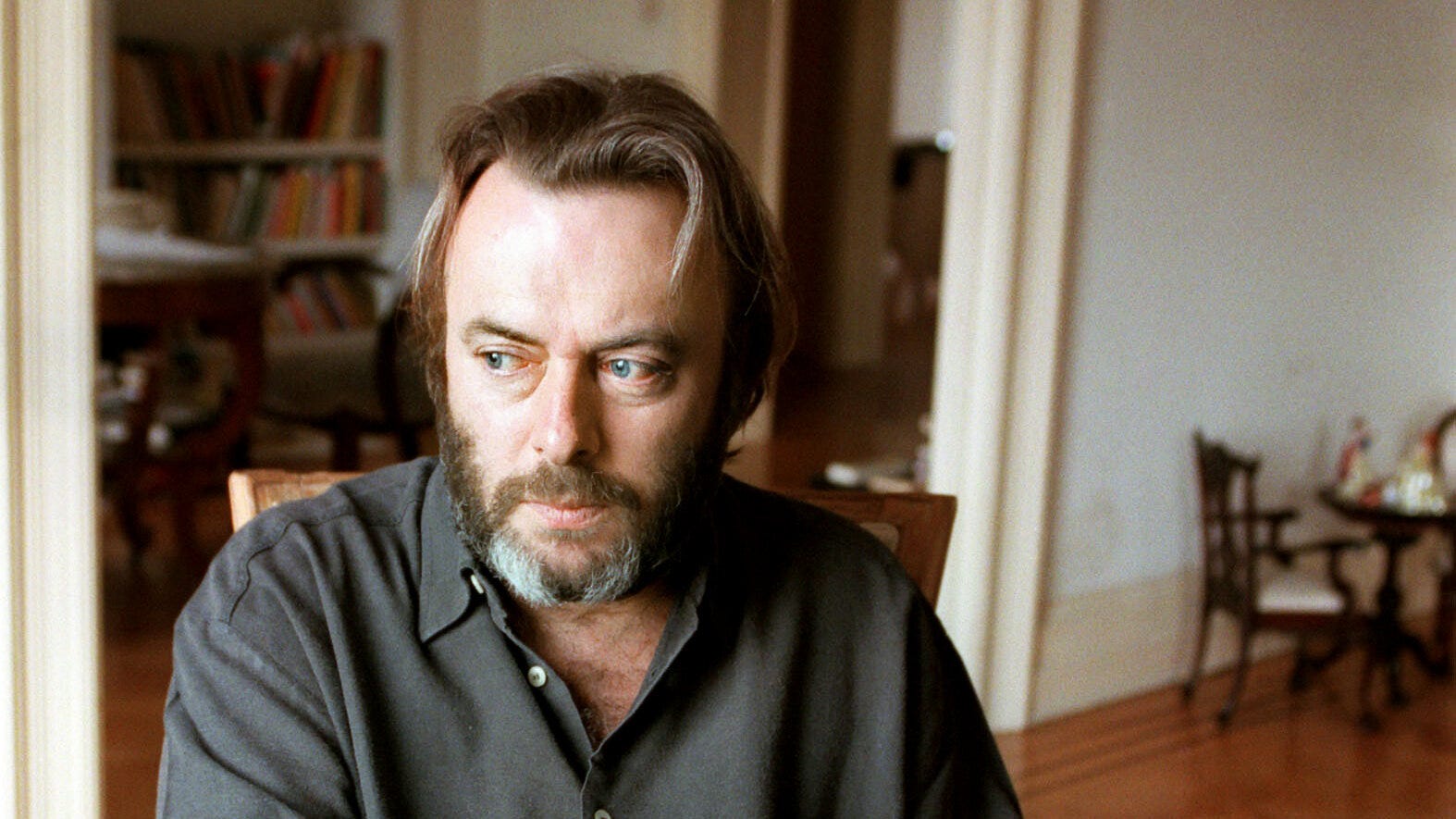
Today marks the fourteenth anniversary of Christopher Hitchens’ death. In 2009, ahead of the inaugural Festival of Dangerous Ideas, I interviewed Hitchens for The Punch. In 2014, I wrote something on the anniversary of his death for SBS.
More recently, in 2022, I reviewed Ben Burgis’ Christopher Hitchens: What He Got Right, How He Went Wrong, and Why He Still Matters for The Monthly. Given that this piece is still behind a paywall, I have reproduced it, with minor cosmetic edits, below. I have also included the transcript of my original 2009 discussion with Hitchens, which only a few friends have ever read in full. We were meant to talk for fifteen minutes. We spoke for ninety. It was nice to read it back again. I was worried I was going to come across as more obsequious than I do, which is not to say that I don’t come across as obsequious at all.
I’m not putting a paywall up on either of these, though I may add one to the transcript later. I was paid for both at the time. I would hope, though, that you look back on some of the other bits and pieces I write and decide that my efforts are worth it.
In 2009, when I interviewed Christopher Hitchens in anticipation of his appearance at the inaugural Festival of Dangerous Ideas, I used our last ten minutes together to ask his opinion of, among other things, Australian journalist John Pilger.
“I remember thinking that his work from Vietnam was very good at the time,” Hitchens said. “I dare say if I went back and read it again, I’d probably still admire quite a lot of it.” He proceeded to describe Pilger as unthinkingly anti-American, but it was the generosity of his preamble that struck me most at the time.
Such generosity has not, as a rule, been extended in kind to Hitchens. For his critics, at least on the left, there is little interest in returning to his work that predated September 11, 2001, and none at all in revisiting that which followed. Though there had been other, earlier disagreements, it was the attack on the Twin Towers and everything it precipitated, especially in Iraq, that came to define the man and his legacy. His unwavering support for the War on Terror was and remains a rupturing apostasy that colours the entirety of his output in either direction.
Ben Burgis’ new book, Christopher Hitchens: What He Got Right, How He Went Wrong, and Why He Still Matters, presents itself as an attempt to redress this. It is a book in the vein of Hitchens’ own slim volumes on Bill Clinton, Henry Kissinger, and Mother Teresa—only, as I’m sure Burgis would concede, not nearly as eloquent. As an attempt to explain, if not to excuse, Hitchens’ position on the war in Iraq and to demonstrate the ways in which he otherwise remained a progressive, if not a socialist, until the end, it is relatively successful. As an argument as to why it still matters that Hitchens held any of these positions it is decidedly less so.
Burgis is a columnist at Jacobin, which has been described as “the closest thing to a flagship publication” of the Democratic Socialists of America, and his commitment to progressive politics and causes is everywhere apparent. This, and the fact that he has clearly done his reading, renders him as good a candidate as any to undertake such a re-examination from the left. Unfortunately, he is also a philosophy professor at Georgia State University, with an abiding interest in the metaphysical. As a result, he dedicates an awful lot of time to the dominant but least interesting strain in Hitchens’ late output, and does so in a way that fails to add much to our understanding of the man. His discussion of Hitchens’ militant atheism, and the writer’s debates with various believers, mostly involves pointing out the arguments that Hitchens could have made but didn’t, or that could have been levelled against him but weren’t. All of this is interesting enough, to the extent that any abstract philosophical argument is interesting, but it is difficult to see how any of it is very pressing today. This is not even stage-setting so much as throat-clearing.
The same is true of Burgis’s brief discussion of Hitchens’ drinking, about which he is, kindly but disingenuously, content to take Hitchens at his word. I suspect that Hitchens was protesting too much in the passages Burgis quotes on this matter. (I once saw Hitchens try to put a tumbler of whisky into his breast pocket, so the notion that he was a high-functioning alcoholic, but not a drunk, doesn’t ring true to me.) But there are, as Burgis also observes, dipsomaniacs on both sides of the political aisle. A person’s capacity for drink, or lack thereof, only ever seems to come up in argument when partisans are not content to argue a point on its merits. In any case, Hitchens’ daily alcohol intake, which he once said could “kill or stun the average mule” (a construction, I would note, that de-escalates in an unsatisfying way that suggests that it was itself dashed off under the influence) no longer seems something worth litigating.
Much more interesting is Burgis’ discussion of Hitchens’ Trotskyism, and of his gradual move away from socialism, if not as an idea worth fighting for, then at least as something that might one day be won using the methods he had previously championed. The centrepiece of the book is a lengthy chapter entitled ‘Hitchens in Nine Debates,’ which examines nine public appearances that Hitchens made between 1986 and 2009. They have by and large been selected to chart this political transformation over time.
And so we see, in 1986, Hitchens sounding “in almost every way like a very orthodox Marxist,” as he argues for a classless society against a couple of hapless acolytes of Ayn Rand. We see, in a 1999 debate on Britain’s membership of the EU, Hitchens supporting the organisation as what Burgis calls “a modest counterweight to the American colossus,” while saying “almost nothing about the organised working class”. At first, it seems that the revolutionary has come to be replaced by the incrementalist liberal. We are soon to learn that this swerve was indicative of something far more destructive than that.
The best chapter in the book—the one that justifies the whole project, but which could just as easily have been published as a standalone article in Jacobin or elsewhere—deals with that subsequent destruction. Burgis begins by carefully and convincingly rebutting the usual reasons leftists give for Hitchens’ support of the war: Islamophobia, opportunism, alcohol-induced brain damage, the all too familiar left–right trajectory of the old and infirm. He reiterates, for those who stopped reading Hitchens at around that time, that the man remained a progressive on virtually every other important issue (most notably Palestine) even as he shilled for war. Burgis’ own analysis is as follows: sometime after the end of the Cold War, “worn down by the political atmosphere of the 1990s, where every talking head in the world took it for granted that the great struggles between visions of how to organise society […] had ended with the fall of the Soviet Union,” Hitchens ceased to see socialism as the most likely outcome of world-historical change, and similarly ceased to see the working class as the most likely agent of that change. Crucially, though, he still thought that some kind of change was necessary, and that it had to be spearheaded by someone. “Lacking any other plausible agent of democratic change in the Middle East,” Burgis writes, “he was willing at last to turn to what he knew damn well was still an empire.”
While I think that this conclusion is accurate—that Hitchens, as I have seen it put elsewhere, was wrong for the right reasons—I have certain quibbles with how Burgis reaches it, which is to say a little too neatly. While he concedes that Hitchens’ revulsion for religion probably did predispose him to anti-Islamic sentiment, his failure to mention some of Hitchens’ more vile and frankly bloodthirsty comments in the wake of September 11 is rather too convenient. Similarly, while he is undoubtedly right that Trotskyism is not always a fast-track to neo-conservatism, I think he is wrong to discount the role that Trotskyism played in Hitchens’ ideas about why and how the war should play out. For while Trotskyism’s socialist end goal is obviously not shared by liberal interventionists, let alone by neo-conservatives, it shares with both these schools of thought similar notions about how history is or ought to be made. This, along with Burgis’ pesky “at last,” warrants at least a little discussion.
It is now somewhat taken for granted that Hitchens had, as early as the Falklands War, shown a willingness to support the use of imperial power against what he saw as its fascistic equivalent. But it should be noted that there is next to no evidence of Hitchens actually supporting that war in any of his published writing prior to the last decade of his life. While I suppose it is possible that he could have chosen to keep his opinions to himself on that occasion, this would have been wildly uncharacteristic, and indeed it seems far more likely that he rewrote his position, most notably in Hitch-22, when he thought it might serve as a useful precedent. (As with much of what he wrote about Iraq, directly or indirectly, this calls into question his intellectual honesty, which Burgis elsewhere applauds in a lengthy discussion of Hitchens’ attack on Martin Amis’s Koba the Dread.)
Far more relevant is his support of NATO’s intervention in the Balkans, a cause he championed at precisely the same time that he began to show signs of believing that bourgeois-capitalist institutions might have greater revolutionary potential than the masses. Later, no doubt buoyed by the interventions in Bosnia and Kosovo (which were, in my opinion, both just and necessary), Hitchens would take to calling the American Revolution, in Burgis’ words, “the only revolution […] realistically available for export.” In fact, he was already praising the American Revolution, if not claiming it was the only game left in town, as far back as 1992. (The earliest instance I am aware of appears in a piece he wrote for The Nation that year, in which, I’m sorry to say, he all but justified the dispossession and genocide of the Native Americans on the grounds that the founding fathers were men of the Enlightenment.) This is important to the extent that, coming as it did three years before the massacre at Srebrenica, it means that his support for NATO intervention may not have been entirely predicated on necessity or a sense of last resort.
The problem was not, as Burgis would have it, that Hitchens had lost the Trotskyist’s ability to recognise and refuse false dichotomies, such as that which existed between the crimes of Saddam Hussein and those that would attend any American invasion. (Hitchens would in any case have argued, and did, that that was the false dichotomy.) It was that he hadn’t lost the Trotskyist’s belief in Lenin’s theory of the vanguard party: the notion that democratic revolution, in the Middle East or elsewhere, required internationalist revolutionary leadership working on behalf of the oppressed (“a disciplined political vanguard”, as the International Bolshevik Tendency put it in a 1998 edition of Trotsky’s work, which is to say, if you squint just so, a coalition of the willing). It is precisely because he no longer believed in the working class as a historical agent, let alone the subject peoples of the Middle East, but still believed in the necessity of revolution, that he made his peace with war and subbed out the proles for the military-industrial complex. That the American Revolution had, from the very beginning, failed to live up to its own lofty rhetoric was neither here nor there. Hitchens had, after all, already spent the better part of his life arguing the Trotskyist line that the Russian Revolution had been betrayed and that its animating principles were still valid. The problem was that he remained a revolutionary and was ready to take revolution where he could get it.
Had this grand bargain ultimately worked out—which, because of the actual aims of the neocons with whom he was now in cahoots, it was never going to—and had the invasion somehow sparked a wave of democratic uprisings in the region, it would have been, as Hitchens might have put it, one of the great historical ironies of which he was so fond. It was precisely this taste for irony that led him to claim that he had supported Margaret Thatcher’s adventurism on the grounds that it would be a blow to Argentinean fascism, and indeed that led him to believe, against all the evidence, that an American court might one day try Henry Kissinger. But the irony was not to be. It was instead as though Fukuyama’s “end of history” thesis and Trotsky’s theory of permanent revolution had mated and spawned Abu Bakr al-Baghdadi. That his position was morally and strategically catastrophic is a point on which Burgis and I agree. I just think that it was more of a piece with Hitchens’ past than Burgis is willing to credit.
The chapter on Iraq all but closes the book, and, to the extent that it at least complicates the standard narrative around Hitchens’ last decade as “a drink-soaked former Trotskyist popinjay”, it is a worthy effort. All that remains is to somehow justify that overlong subtitle. But on the matter of why Hitchens still matters, Burgis ultimately has little to say.
It could be argued that Hitchens stills matters on the grounds that the consequences of the wars he championed are still being felt, not only in Afghanistan and Iraq, let alone the wider Middle East, but also in the United States, where the economic, social and political ramifications of those wars include last year’s Trumpist insurrection. It is a political truism that presidencies beget presidencies, and a black first-term senator with a questionable middle name, running on a nebulous message of hope and change, could never have won a general election had it not been for Bush’s disastrous wartime presidency. It is similarly true that white America might not have seen any need to make America great again had it not just spent eight years fulminating at the fact that there was a black man in the White House.
But Hitchens, while certainly a vocal supporter of the War on Terror, was probably less important to it happening than the lie-laundering editorial boards of The New York Times and The Washington Post, and to the extent that those august institutions are still with us, well, they really do still matter. If there are arguments to be made about Hitchens’ explicitly socialist writings prior to the mid 1990s, and how they might teach us something about how to operate as a left-wing commentator in the belly of the beast, Burgis doesn’t bother making them here, not least because the media landscape has changed and there are better and more relevant examples to hand. I have previously suggested that Hitchens’ willingness to directly test his assumptions with lived experience—whether by allowing himself to be waterboarded or by spending time with revolutionaries in the places about which he wrote—remains a valuable lesson to younger journalists, though that probably doesn’t warrant an entire monograph and in any case isn’t the subject of Burgis’.
Instead, he writes that Hitchens was always worth reading, even when you disagreed with him. He writes that the quality of political punditry—in literary terms, at least—has declined since Hitchens’ death. He makes in fact the direct opposite argument to James Marriott in The Times, who marked the tenth anniversary of Hitchens’ passing by blaming him for the pugilistic nature of contemporary public discourse. Both arguments, to borrow from Burgis, are pretty weak tea.
My own position, such as it is, lies somewhere between them. It is a shame that Burgis chooses to write about nine of Hitchens’ debates instead of nine of his essays or articles, not least because there’s nothing quite so boring as reading someone recap a YouTube video. It seems a missed opportunity to judge Hitchens on the terms by which he would have wished to be judged. Yet it also seems somehow fitting. I would wager that anyone who has discovered Hitchens since his death has done so not through his writing but precisely through such videos. For anyone who has read his work from the 1980s and early 1990s, as collected in Prepared for the Worst and For the Sake of Argument, this is a little galling. There is no comparison between the dense and dazzling prose of those collections (not to mention their stridently left-wing politics) and even the most amusing “Hitchslap” of some unfortunate rabbi or bishop online. There is certainly no comparison between those collections and his later novelties for Vanity Fair and the Slate columns, which he dashed off between courses at dinner parties. While his literary criticism for The Atlantic, as well as the Vanity Fair pieces about his cancer collected in Mortality, put paid to the notion that his literary talents were slipping at the end, it might have been useful to have examined the way that his writing either soared or suffered in direct proportion to the quality of his ideas. Even allowing for his infamous piece about women not being funny, his worst writing qua writing, in the last decade of his life, was, without exception, about Iraq.
It wasn’t just the ideas, though. It was sometimes difficult not to feel that, between the television appearances and debates and deadlines, Hitchens was, even before his cancer diagnosis, beginning to spread himself a little thin. It was his editor at Vanity Fair, Graydon Carter, who wrote the most honest appraisal of his friend, recently noting that, although Hitchens was “catnip to television-news bookers,” the junk high he got from those television appearances probably wasn’t good for him. Carter meant good for Hitchens physically, but I think it was also true for him as a writer. (Carter also admits that he is unsure whether Hitchens would be “on the lunatic left-wing fringe or the lunatic right-wing fringe” today. I suspect that the opposite, or some version of the opposite, is true, and that Carter is merely being polite. Hitchens’ hatred of the Clintons may not have been enough to have pushed him into the Trump camp, but it would certainly have been enough to have rendered him a Greenwaldian figure, cantankerous and adrift. He was already one of Fox News’s pet leftists when he died. What reason is there to think this would have changed had he lived?)
But while I return to those early collections regularly, as well as to Love, Poverty, and War and Unacknowledged Legislation, I recently surprised myself by telling a younger reader not to bother with them unless she was specifically interested in the history of US political-literary journalism in the waning days of the twentieth century. The truth is that, unlike Orwell, Hitchens never wrote a great standalone book, and for that reason alone I suspect that, without YouTube on hand to prop him up, he would have already gone the way of many a jobbing hack before him. (Coincidentally, I have also been rereading Orwell’s essays, and, as great as some of them are, I doubt we would still be reading them, either, were it not for the ongoing popularity of Nineteen Eighty-four and Animal Farm.)
The fact is that Burgis’ subtitle is a bit of a false flag. Hitchens still matters because he still matters to Burgis, in the same way that Hitchens still matters to me. He matters to us because we came to him young, because he influenced our writing and the development of our ideas, and, as is so often the case with one’s heroes, because he ultimately disappointed us. He matters because all cautionary tales matter, and Hitchens’ final decade, in so many ways, was nothing if not one of those. I remember thinking that his work on the Reagan years, on Cyprus and Palestine and Kissinger and Wodehouse, was very good at the time. I dare say if I went back and read it again, I’d probably still admire quite a lot of it.
Interview with Christopher Hitchens
23 September 2009
CHRISTOPHER HITCHENS: Hello.
MATTHEW CLAYFIELD: Hello, is that Christopher?
CH: Yes, it is.
MC: Christopher, it’s Matthew Clayfield from The Australian in Sydney. How are you doing?
CH: At your service. I’m sorry, I had a rather late night of it last night.
MC: That’s fine. I’m having a late one now as it happens.
CH: Hold on. Hold on a minute.
[Background noise.]
CH: What book? … Yeah. … She wants it now? … I’ll have to have a look. … I think it’s alright, but I may need it to fact-check with Newsweek. … Don’t promise it today. … Yes. … Shortcut? Yeah.
[Background noise.]
CH: Sorry.
MC: No, no, that’s fine. No, I didn’t know earlier when I was calling. It’s always funny when the time difference is such that no one really knows what the go is. But yes, now we’re in contact and there you go. So, look, I thought I’d start with... I obviously realise that you’re coming over here to talk at the Opera House about religion and about the subject of God Is Not Great, which I actually recently finished…
CH: Oh, good. That’s very flattering. I can’t ask for more than that.
MC: No, well, I mean you were preaching to the converted in this case, I have to say. But I’ve handed it onto people who might find it a bit more confronting, hopefully, with any luck.
CH: Well, that’s why it’s been a success, if I can say it myself. And who else was going to be able to do it? I mean, I wanted it to be a challenge to people who were not of my way of thinking. And the reason it became a bestseller, according to the Wall Street Journal, which did a piece about this, is that the word was put around by Christian bookstores and people like that, that this is the one you have to beat.
MC: Yeah.
CH: And also it’s the “know your enemy” book. As a result, I get invited by religious institutions, not less than about twice a month, to come and talk.
MC: I was going to say, you must be going to an exorbitant number of debates.
CH: Yeah, well, I like doing that. And I’ve also, I mean, I’ve condemned myself. It’s just as well I do like it, because I said at the outset, you know, I wouldn’t refuse any challenge. And you know, compatible with actually staying alive and not collapsing, I have, I think, not yet turned down anyone who’s asked me to come and defend my position.
MC: Well, one of the things you say in Letters to a Young Contrarian is that it’s the one debate you never get sick of, and you always enjoy debates with people of faith.
CH: Yeah, that’s absolutely true. I find it is a subject that doesn’t become dull.
MC: Why is that?
CH: Well, I think because it is the essential argument. I mean, all other arguments in a way descend from this one. You either believe in the consolations of religion or the reflections of philosophy, and religion is sort of philosophy with the hard questions left out. You can tell a great deal about someone from whether or not they believe they’re the object of a divine design or not.
MC: I think so as well, yeah.
CH: And it’s not a minor difference of opinion. It’s a fundamental difference. So, religion is to philosophy what astrology is to astronomy, alchemy to chemistry, and so on. It was humanity’s first attempt to make sense of things. I mean, it was the first attempt to have cosmology. It was, in some ways, the first attempt to have health care. And, in a quite important way, it’s also our first attempt at literature. I mean, especially, I think, that’s true of the Christian and Jewish books, and also of the Koran. You know, for centuries it was probably the only book many people had read or, if they couldn’t read, knew some of and could recite.
MC: Yes.
CH: Especially in King James Version, which I know I praise in the book, it is a great work of literature. The difficulty arises when people say it’s not human, that it’s beyond criticism because it’s the word of God and so on. That’s all balls, of course.
MC: Which is also, I mean, it’s such a shameful act of self-denial. I mean, it’s such a great work of human work.
CH: Yes. In the King James Version, which is indeed the only useful book I know of that was written by a committee.
MC: Yes, that’s a good way of putting it.
CH: Well, the American Declaration of Independence, though it’s largely written by Jefferson, was written by a committee of four people, but they were all pretty good. And they knew enough to let him get on with it.
MC: Yeah, have his head.
CH: They didn’t too much editing. And the only editing that I personally know about—I’ve written about Jefferson, also—
MC: Yes.
CH: —the only editing I personally know about is Benjamin Franklin says, “Wouldn’t it be better to say, ‘We hold these truths to be self-evident?” And I can’t now remember what Jefferson has originally put. Shit. I should know. Anyway…
MC: I’ll look it up.
CH: Yeah. And “self-evident” is absolutely perfect for the rhythm of the thing.
MC: Yes, the cadence of it’s fantastic.
CH: Though I don’t myself think that there are—well, that’s another question.
MC: No, but I mean you could count them certainly on the fingers of one hand.
CH: [Laughs.]
MC: These, you know, the great committee books of world literature.
CH: Well, there’s really very, very few. I mean, the Koran was not written by committee, but in its finished form it was assembled by a number of people. It’s just that they can’t afford to admit that.
MC: No, of course not.
CH: Which is a shame, because they’ve made a fetish out of this now.
MC: Yeah, they have. Look, I’ll go to just some things that I got written down about Australia and religion. I’m not sure if you’re aware, but not much more than a year ago, the Pope brought over several hundred thousand Catholic young people to Sydney, and I was covering that, this was for World Youth Day…
CH: Yeah.
MC: I saw Mexican teenagers venerating the crucifix and things like that.
CH: Yes.
MC: And, you know, in this ridiculously overblown Passion play, Pontius Pilate washing his hands of Christ on the steps of the Opera House. And now of course you are being brought over to speak in the Opera House. That’s got to be some kind of progress, doesn’t it?
CH: It wouldn’t be for me to say that.
MC: [Laughs.]
CH: I’d be perfectly happy if you thought so. How many people does the Opera House hold, by the way?
MC: You’re, I think, in the Concert Hall, which as far as I’m aware is eight hundred or something…
CH: Right.
MC: I know that it’s selling out pretty quickly.
CH: What’s the main… I mean, I’ve been to it. I’ve been to an opera there. Long time ago. And I can’t remember what the capacity is. I was just interested.
MC: I’m looking it up right now to tell you. What’s your take on this idea of World Youth Day. Because I know, I think, this was the one that the bulldog tried to bribe kids to come with absolution, wasn’t it?
CH: Yes.
MC: Yeah.
CH: Well, I mean, this Pope, who’s an extreme reactionary—
MC: Yeah.
CH: —has proved that, I think, in three ways. One is he wants to return the Mass to Latin. He’s made a few steps in that direction. Second by letting the Lefebvre fascists back in. I’ve just forgotten his name. The Englishman, I think he is, by origin, who was actually living in Argentina… Oh, this is ridiculous. But you know what I mean, the Marcel Lefebvre extreme right, who had been flung out because, well, they just didn’t accept the Second Vatican Council, basically. And also they didn’t want—I think, personally—they particularly did not want to drop the general condemnation of the Jews for the death of Christ.
MC: Yeah.
CH: In other words, they’re sort of Mel Gibson-ists.
MC: Yeah, I was going to say.
CH: To mention a famous Oz type.
MC: I think in this case we’ll give him to New Zealand. [Despite the fact he wasn’t born there. — Ed.]
CH: Anyway, no sooner was this guy restored to the fold, that he, you know, he went on again about how there was no Holocaust and how the Jews are a menace and all this sort of thing. But it matters more to the Pope to have these few back in the fold than it does to make an obvious compromise with, you know, the fascist past of one wing in the Church. That’s another case. And the third is, I think he wants say it again, a bit more affirmatively, that the Catholic Church is not just another Christian church, it is the only one, the one true one. This ecumenicism has gone too far.
MC: Yeah.
CH: And then, actually, I make it four. I mean, what I would call, it’s not exactly the sale of indulgences, but the offer of the remission from future punishment if you do the Church a favour or two.
MC: Which is terribly retrograde.
CH: Well, I think so, I have to say. There may be some other things that show that he wants to go back to pre-Vatican II, but those are the four most salient ones.
MC: I think the thing that really struck me while I was covering it—as I said, I saw, you know, I spoke to kids from South Carolina who were considering vocations and things like that—
CH: Yeah.
MC: —I was really—and I went through Catholic primary school until grade seven, which I think was the best way of deciding that I didn’t believe—but I was struck by what seemed to me to be a preying on the youth. And that is something you write about quite extensively in the book.
CH: Yes. I mean, I think that it’s very questionable whether anyone should be compelled, by family or by school, to attend any religious event. It would be very, very difficult indeed to forbid it, and I don’t think one should probably try, but that doesn’t mean that general social approval of it should be automatic.
MC: No.
CH: I think people should look sort of slightly askance at people who do this to their kids. I mean, for example, when I used to live on Capitol Hill in north-east Washington—I live in a different area now and also in an apartment building, so I don’t get door-to-door salespeople, because I live on the top floor of an apartment building—but when I did live on street-level, it’d be a hot day, and you’d answer the door, and there’d be this beautifully dressed, usually black, family—
MC: Yeah.
CH: —who said, “Can we just come in for a second, the children are very thirsty, and sit down?” It was quite hard to say no, even when you knew what this was. It was a Jehovah’s Witness job. So, what I would do is I’d look directly to the children and say, “You know, you don’t have to do this. Your mummy and daddy shouldn’t really be dressing you up like this on a hot day and dragging you around to other people’s houses.” I’d try to embarrass the parents in front of the kids.
MC: How did that go?
CH: Well, for a lot of people they’d say, “Look, it’s their religion, it’s their right.” Yeah, okay, okay. I can’t stop them. But I can withdraw approval from it. And I think one should take that line with people who say, “Of course we’re sending little Johnny to Saint Ignatius” or whatever it is, or making them go to Sunday school, blah blah. And then I think it should be certainly illegal to perform any operation on the genitals of the child that isn’t mandated by surgical or medical necessity.
MC: Sure.
CH: No non-elective surgery for children, of any sort. I mean, I think that should be straight to jail. As it is if you do it to women, to little girls, in America, but not to little boys. I think it should be across the board. Just as, you know, we say to the Mormons, Utah can remain a state of the Union only if you give up, not just polygamy, but what polygamy’s really a cover for, which is marrying underage girls to filthy old male relatives who can’t get laid. They still do that, but when they get caught they go to prison. As they should. And the same with people who on religious grounds, so-called, you know, won’t take their kids to the doctor or give them a blood transfusion. Straight to jail, children taken away.
MC: At the same time…
CH: I think we need… I think a few more high-profile legal and other moral cases of this kind would do an enormous amount of good because what needs to be challenged is the idea that religious belief confers some sort of moral standing on a person.
MC: Yes. At the same time you do believe, and you’ve written about this, in the importance of young people having some religion in their education, or rather some education of religion.
CH: Oh, yes. And by the way, on that, I believe equally strongly in a way, and I think it’s the sort of thing where one can and should in a sense offer a quid pro quo, because… In America now, because of the so many possibilities of offending people, the schools play it safe. So, if you wanted to have a voluntary Bible class—what was it that I read about the other day?—something perfectly harmless that the school just decided to forbid just to be on the safe side—
MC: Yeah.
CH: —which has the dire effect on children, I mean, growing up who don’t know what’s in the Bible. I mean, my daughter wouldn’t know if it wasn’t for me, and it’s rather absurd for me to be teaching her this stuff.
MC: [Laughs.]
CH: But I mean I think it’s essential that people do know and that it is properly and intelligently and objectively studied.
MC: See, I agree with that entirely. I think my Catholic education was integral to the position that I now hold. And I also just think that… But it’s also important obviously to learn about all the religions and it’s only when you can start to do that that you can draw the similarities and apply logic to it.
CH: By all means, one certainly has to do that. But again I revert to this point about the literary element. If you don’t have some kind of working knowledge of the King James Version—actually, it wouldn’t really be the King James Version, as that was done around the time Shakespeare himself was writing, but let’s say of the Bible in English—there will be references in Shakespeare that you simply won’t get. And Milton, too. And, well, indeed innumerable other writers. So it just has to be part of any educated person’s equipment. I don’t think they teach much Bible study, do they, in Catholic school?
MC: Well, look, I came out with a fairly good working knowledge of—certainly of the New Testament and of certain aspects of the Old Testament. Obviously, they, in primary school, they avoid going through, say, all the books of the Old Testament and what not. But I still came out with a fairly good working knowledge, which, since then, I’ve supplemented.
CH: Oh. Maybe it’s a foul Protestant-[inaudible] rumour that the Catholics don’t really like their children to look at the Bible too much.
MC: Well, I remember when I read Revelation—
CH: Ah, yes.
MC: —the school were kind of disturbed that I would be doing so. I’m not sure what upset them about that so much.
CH: Well, it’s pretty wild stuff, that.
MC: Oh, it’s a rip-roaring ride. We have a Prime Minister here called Kevin Rudd, and before he became Prime Minister he wrote a seven thousand-word essay for a magazine we have here called The Monthly, which was entitled ‘Faith In Politics’. You might actually want to—I believe it’s on the web. In it, he argues quite extensively about the relationship between religious belief and the state, and he turns to the figure of Dietrich Bonhoeffer, whom you write about extensively in your book. And I just want to read you this sentence from—I mean, obviously it’s out of context of the whole essay—but at one point he says: “I argue that a core, continuing principle shaping this engagement (between faith and state) should be that Christianity, consistent with Bonhoeffer’s critique (of the 1930s), must always take the side of the marginalised, the vulnerable and the oppressed. As noted above, this tradition is very much alive in the prophetic literature of the Old Testament.” And I wondered what your response to that would—
CH: Well, I think it’s just… I think it’s simply wish-thinking, that. I mean, Christianity is in Australia because it became the religion of Roman imperialism. That’s the only reason why it had the luck to have spread all over the world in the form that it did. Because of the conversion of Constantine. And it’s always yearned—it’s just as likely to be an ally, and for most of its life has been the ally, of the Establishment, the rich, the forces of law and order, and so forth. And the reason why Dietrich Bonhoeffer is so well-known is that there was a search to find a decent Christian or two in Germany when all this had been going on, and they found about two, and—
MC: Jagerstatter, wasn’t it?
CH: Yes. Well, Jagerstatter’s… It’s very interesting. I don’t know what’s happening about him, but I was actually just about to mention him. I mean, when, you know, the Pope… The Church wasn’t able to find a Holocaust saint or a Final Solution saint until very, very recently. Maximilian Kolbe. Who had actually been—he may or may not have done what they say he did in Auschwitz, but he seems to be quite a brave guy. But unfortunately during the thirties, he’d helped publish a pretty rabidly anti-Jewish magazine in Poland. So he’s far from ideal and he’s the best they could come up with. Because Jagerstatter did refuse constriction, and I think was beheaded, but while he was awaiting execution in prison, the priest all came to him and said, “Look, you don’t have to do this.”
MC: Yeah.
CH: “In fact, you know, if the army calls you, you’re supposed to say you’re going to go.” So, he may have said: “My religion forbids me to do it,” but they kept saying, “No, you’re mistaken about that.” So, it’s purely subjective for Rudd to say that, and it may be something he might wish to be true. But there’s nothing in Christianity that does oblige you to take the side of the poor and the downtrodden. In fact, there are many instructions very strictly to the contrary.
MC: Let’s move outwards slightly…
CH: Christianity in some ways is anti-Capitalist, you could say, because it’s against the making of money, basically. It’s against the material world.
MC: Yes.
CH: Which is completely futile. It says… It contains many immoral injunctions, such as, you know, “Take no thought for the morrow.” So, any idea of thrift or saving or preparing for children’s sake, that’s all nonsense, because the man uttering these injunctions believed that the world was coming to an end.
MC: Yes, and most likely wished it.
CH: Yeah, well, certainly did, and promised it as if it was a good thing and said that he would be back in the lifetime of those who knew him. Which is what gives rise to that terrible story of the Wandering Jew.
MC: Yes.
CH: Because someone has to stay alive. I don’t know if you know this, but at any rate, I forget if it’s in my book or not.
MC: Yes, yes. No, the Wandering Jew is.
CH: It’s absolutely… I think it’s shit, basically. I mean it’s pure rile, and futile, to try and use Holy Scripture so-called to support any political position, and I deeply distrust anyone who does. But it would certainly… You know, some Muslims believe, or talk as if they believe, that, you know, Islam is the religion of the depressed and the downtrodden. It certainly does have an appeal to some people who are very poor, but I mean look what an Islamic Republic is like.
MC: Of course, and that’s where I was going to go next. The sort of political uses to which Islam in particular has been put. And obviously I don’t want to pick on Islam when I say this. The only reason I’m bring it up in particular is because of current events, and actually a lot of your recent writing has revolved around two sorts of—
CH: Oh, yes.
MC: —important, two very important, points. I’ll mention them to you, both, and then we’ll do them one at a time. The first thing is obviously the Islamic theocracy in Iran and the military coup earlier this year, and the second is the decision by the Yale University Press—
CH: Yeah.
MC: —not to publish the Danish cartoons. We’ll go with that one first, if you don’t mind. I was wondering, what is it, to you, what is it about the mainstream media, and now an academic publishing house, that makes them so willing to concede on a point that seems like a fairly fundamental line in the sand?
CH: There appear to be three things involved in the case at Yale. I mention them in no particular order of importance. One is, it seems, that they had—this something we didn’t know at the time the press made this decision, which we now do know—the university did involve itself. The university expects a very large donation to be coming its way from Saudi Arabia. In fact, this is an undisclosed element in the [inaudible] of quite a lot of universities, I think. Now, it’s not that they’re being offered it in order to shut down a book. It’s not as crude as that. It’s just that one of the things they take into account is endowment. And one of the things that’s very important there is the likelihood that a great deal of money might—or, therefore, indeed might not—come from Saudi Arabia.
MC: Yes.
CH: And that’s… You know, I think that’s important across the board, really. It appears to be involved, in this decision, at least in the background. It was in the minds of some of those concerned, shall we say. Second, I think there is the fear of reprisal, though it’s not quite clear against who the reprisal would come. That was certainly the official reason given, though, as I said in my article, which obviously you see to have been kind enough to read, they got that wrong, too, because they said that publishing the book would instigate violence. Instigating violence means that you hope and believe it will happen and act accordingly.
MC: Yes, this—
CH: So that was— That’s completely different from saying, “We have to weigh the consequences of possible reprisal.” Well, of course, that is indeed the cost of free speech. But to phrase it in that way is to give up the battle over free speech as if there was no such thing.
MC: Yes.
CH: Not as if you’d discussed it in another way. And then the third, I think, which also is quite pervasive now, not just in publishing and in the academy, but elsewhere, is a version of multiculturalism, or multiculturalist etiquette, whereby you pre-emptively don’t offend anyone by not publishing anything that anyone could really disagree with. And again, this has a tremendously depressing effect on the culture.
MC: Oh, I agree entirely.
CH: Those three things, all of them involved—and look, all of them, as you’ll see, very ignoble—
MC: This idea about not offending I find poisonous, to be honest.
CH: No, well, it’s absolutely—the number of groups in a multicultural, multiethnic society who could in theory exert veto is very, now, really quite large, so if you made the concession at all, it’s extremely likely you’ll start making it across the board, and this has in fact happened in Britain. The Sikhs, who we hadn’t heard from for a bit, took against a play written by a Sikh woman that showed some of the less adorable side of Sikh life—I can’t remember exactly what was at issue—anyway, this play got taken off. And so on and so forth. It becomes very, very difficult to refuse it to anybody if you concede it to anyone.
MC: Yeah.
CH: As for the Islamic Republic, I mean, long before he wrote The Satanic Verses, I thought that Salman Rushdie’s book, Shame, about Pakistan, was in some ways his masterpiece. I still think it’s better than Midnight’s Children, actually, because it showed, very calmly and in some ways quite humorously, how the whole idea of an Islamic republic is a ridiculous one. You can’t… Religion cannot define a nationality. And Pakistan—the first state to sort of proclaim itself, “We’re a country because we are a religion”—
MC: Yes.
CH: —is one of the very few countries to have completely fallen apart in that it’s had to massacre its eastern wing—east Bengal, now Bangladesh—so it’s a huge Muslim-on-Muslim butchery—
MC: Yeah.
CH: —and is now, with its other constituents, quite rapidly unravelling, hovering on being both a failed and a rogue state. Partly because it self-blinds itself, if that’s the word I’m looking for. I mean, proclaiming yourself a holy state just forbids certain kinds of self-criticism, and if you don’t have enough self-criticism then you become stagnant and rotten pretty fast. And this is a danger not just for the people of the region, but I mean everywhere, because we now know what happens with failed states is that they become rogue, and they feel their only chance is to export their violence. That’s the lesson of the Islamic Republic of Afghanistan, the last one.
MC: Yes.
CH: So, that’s what I think about that. But I’m encouraged by the way that all the Iranians I know are pretty sure that they’re going to outlive the Islamic Republic.
MC: Yeah, and it’s also, I mean, it’s a pretty interesting week coming up regarding that I guess, what with Ahmadinejad going to New York and—
CH: Yes.
MC: —the non-proliferation Security Council meeting.
CH: No, it’s fascinating.
MC: Let’s take it out a little further just to some general things. I’m going to throw some names at you. These were names that, in all the articles and books of yours that I have had a look at over the past couple of months—would you believe I only sort of discovered you for myself, I think, in March?—
CH: Yes, I would believe that. [Burn. — Ed.]
MC: —here were the names that I sort of came across that I was hoping you might have an opinion. Some of them you’ll recognise immediately as Australians or expat Australians, and the first of those is John Pilger.
CH: Yes. I used to know him slightly, in London, and I remember thinking that his work from Vietnam was very good, at the time I was reading it.
MC: Yes.
CH: And I dare say if I went back and read it again I’d probably still would admire quite a lot of it, because that’s something I don’t think I’d be ever likely to change my mind about. But there is a word that gets overused, and can be misused—namely, anti-American—but it has to be used about him. There’s something about the United States that means he can’t… He can’t exercise judgement about it.
MC: Yes.
CH: He just doesn’t like America. Doesn’t think it’s a good idea. And according to someone I know who knew him, he was brought up this way. It’s a family thing. So that for me sort of spoils it, so even when I’m inclined to agree I don’t like the tone.
MC: Yes, that’s my big bugbear as well. Even when I agree there’s something shrill that I can’t take.
CH: No, and it reads… It has a sort of robotic feel about it. A bit like, I’m afraid, now, to say, the work of Professor Chomsky has to me.
MC: Right.
CH: It’s lost its… It’s become inelastic. It’s a drone. A drone and a bit of a whine.
MC: I understand entirely.
CH: Yeah.
MC: The next name is someone who you actually reviewed positively either last year or the year before—I forget when the book came out—
CH: Clive.
MC: —and I was pleased to see a positive review of Mr James—
CH: Yeah.
MC: —because a lot of people didn’t like Cultural Amnesia, and, for its flaws, I was nonetheless a big fan. I think it’s an important book.
CH: No, no, it’s a very important book, and I was terrifically impressed, as someone who is, in a small way of business, in the same—I’m in the same racket—but he wrote those pieces not for publication. It’s not a collection of his stuff. These are things he wrote to please and instruct himself. And writing for the bottom drawer—if you have a family and all the rest of it—is very difficult to do. I absolutely need the spur of publication and, indeed, remuneration.
MC: [Laughs.]
CH: I wouldn’t do it for nothing. If I was in jail, of course, I would do it. But to do that level of stuff, I suppose with the eventual hope of publishing it as a book, but, you know, every now and then you’d go off on your own and write a piece about, oh, I don’t know—
MC: Ellington.
CH: Sorry?
MC: Duke Ellington.
CH: [Laughs.] For example, yes. Well, he’s extraordinarily—that’s the second thing to say—he’s an amazingly polymathic guy. And then I also think his latest book of poems, Opal Sunset, contains some absolute gems.
MC: See, it’s very interesting that you say that, because there’s been quite a furore—a minor furore—here, if you like, regarding the decision of a literary review—the one that actually comes out in the paper I work for—to publish Clive James’ poetry. A lot of people consider it—you know, don’t consider him to be a poet at all—so it’s actually very interesting to hear someone as schooled in poetry as yourself—
CH: No, I wouldn’t say he’s—he is—I mean, he is a great—well, let’s just step back a bit about Clive. It’s very difficult to be a comic and be an homme serieux at the same time. Because I think some people used to think he’d done so much clowning on TV that he had lost slightly the reputation that you need if you’re going to be a serious critic. But I think he’s managed to keep the balance really quite well. Though of course, he’s capable of light verse and so forth. It’s bloody good light verse. I’ll give you two examples from Opal Sunset. There’s a wedding anniversary present poem to his wife Prue that’s just terribly sweet and good, and obviously an example of the lighter form. But there’s a poem called Angels Over Ellsinore—it’s about Hamlet—
MC: Yes.
CH: —that’s really, I think, exquisite.
MC: Now, see, it’s very—I think that that was the poem that caused the uproar. [It wasn’t. It was Aldeburgh Dawn, which appeared in the August 2009 edition of the Australian Literary Review. — Ed.]
CH: And I was having dinner the other night with Robert Conquest, who’s one of the greatest living poets in English and also scholars in poetry, and whose good opinion is hard to get and very well worth having, and he just said, “You know, the thing about Clive’s stuff, about Clive’s poems, is that they’re always good in one way or another.” He was surprising—I mean, he doesn’t give compliments very easily, Robert Conquest. His opinion in this case would be more worth printing than mine, but you can say that it was me who told you.
MC: Yeah, second-hand.
CH: So, no, I’m very… I’m pro-Clive. I don’t see much of his—if any, really—of his TV stuff.
MC: No, no, me, either.
CH: Maybe I’m shielded from any other impression. I don’t watch the television.
MC: Next name. Gore Vidal, the man who is on the record as saying that you are disowned as his heir apparent.
CH: Now, he… I saw him sort of slightly take it back, in a really rather jokey way. Someone sent me a tape of him at a meeting in New York. Is that the one you mean or has he done it more?
MC: I’m not sure. I’m not sure. I’ve just seen a… You’re talking to a Gen Y-er. I’ve seen it on YouTube, him saying, “Oh, you know, he was going to be my—”
CH: Yeah.
MC: “—going to be my heir but no longer.” I haven’t seen the recantation.
CH: Right. Well, no, that… I mean, I don’t know if that would have been an actual excommunication. We may well be talking about the same—
MC: Oh, we may be, yeah.
CH: I in any case had stopped using it as a blurb on my book jackets.
MC: Yeah.
CH: After 9/11, I told my publisher not to use it.
MC: Yeah.
CH: He’s still on Unacknowledged Legislation. Because I mean I don’t want to airbrush the past, and I was proud enough of it at the time. But I wouldn’t use it again.
MC: Yes. How long after September 11 was it?
CH: Well, it didn’t take him very long to come out with a sort of Pearl Harbour-ish, pseudo-interpretation. Which I have a feeling he hasn’t reprinted in any of his books. And in his most recent memoir he didn’t go on about it either.
MC: No, no, that’s correct, he didn’t.
CH: He may himself be not that proud of it. But the truth of the matter is—and it’s not as if I haven’t always known this—I mean, Gore is—and you must correct me if I’m being condescending here, but if I said he was a Lindberghian would you know what I’m on about?
MC: Yeah.
CH: I mean, America first, Charles Lindbergh, and that was his first hero. He’s never made any bones of it.
MC: No, no. Well, I mean, he writes about it quite extensively in Palimpsest and—
CH: Yes. He does think Pearl Harbour was a fix. Either that it was collusion by Roosevelt or at least foreknowledge on his part. He doesn’t think the Second World War was worth fighting in. He is in many ways quite a right-wing isolationist.
MC: Yes.
CH: It’s because some people are naïve enough to confuse this with sort of anti-imperialism that they think of him as being rather more to the left than he really is, and there’s an element of I have to say paranoia involved in that, that world outlook, and it keeps popping out. There are times when that can be a curiosity in somebody, but it’s like Pat Buchanan, the extreme-right Catholic writer here—
MC: [Laughs.]
CH: —he’s an America first fan as well.
MC: See, it’s interesting, isn’t it, the way—
CH: But in Buchanan’s case, it’s a bit worse because there’s a sneaking sympathy for fascism in Buchanan. I don’t suspect Gore of that at all.
MC: No.
CH: But it was so dingy to read this tenth-rate little innuendo piece, and I thought, look, 9/11 is one of these things that is, I think quite rightly, thought of as defining—I don’t care how many people think that’s a cliché—and I have no wriggle room on this point at all. And it’s not a difference of emphasis. I mean, it’s, for me, it decides what I think about absolutely everybody.
MC: Yeah.
CH: So, I don’t know… The last time I saw him it was sort of painful. And I have a feeling that probably was our last meeting.
MC: Where was that?
CH: That was at Hay-on-Wye, the literary festival, the year before last. Or do I mean last year? Last year. And he was very… Well, he… It was a rather cold meeting.
MC: Do you regret those—
CH: But I mean I still that his series of novels about the United States—
MC: Yes.
CH: —is a great—really great. Even though one of those does contain the Pearl Harbour bee-in-the-bonnet stuff, still [inaudible] it, that argument is a part of the historical record, no question about it. I think it’s a great series, and I think his book Lincoln within that series is a masterpiece.
MC: Yeah.
CH: I think his novel Julian is one of the great novels about the ancient world.
MC: Lincoln is currently on my pile.
CH: Well, it’s terribly good.
MC: I’ll move it to the top. Next name: Hugo Chávez.
CH: I’ve met Chávez. I’ve flown around on his plane, during the Venezuelan elections.
MC: I’m sure that was an experience-and-a-half.
[Background noise.]
CH: Well, I can see why people find him charming. He’s very ebullient, as they say. He’s got really quite an engaging manner. His English isn’t much good—it’s better than he lets on—but, you know, he’d read some of my stuff and he cheesed me about Trotsky and this that and the other and—
MC: That’s the next name on the list.
CH: I’ve heard him make a speech, which he has a vice that’s always very well worth noticing because it’s always a bad sign: he doesn’t know when to sit down.
MC: Yeah.
CH: He’s worse than Castro was.
MC: Bloody hell.
CH: He won’t shut up. There was a time he stayed on his own TV show for something like twelve hours—I have a note of it somewhere—without going to the loo.
MC: It’s actually inhuman, I think.
CH: Yeah, and it’s always a bad sign. And then he told me that he didn’t think the United States landed on the moon. He didn’t believe in the existence of Osama bin Laden. He thought all of this was all a put-up job. So, he’s a whacko.
MC: Is he a dangerous whacko?
CH: Yeah. I think so. I mean, the ambassador of a neighbouring country—not Colombia, but I can’t tell you—
MC: No, that’s aright.
CH: —anyway, I mean not a country that’s a right-wing military dictatorship or anything of the sort—
MC: Sure.
CH: —said they’re very, very worried that he’s opened a factory in Venezuela for the manufacture of Kalashnikov weapons in great quantity. There’s no possible— Venezuela doesn’t need them.
MC: Yeah. And of course he’s just bought a bunch of Russian tanks as well.
CH: Yes. He spends a great deal too much money on weaponry he doesn’t need locally. So, the question is: Well, where’s it going? And I mean, I think the Colombian allegations against him have been proven correct: that the FARC does get weaponry and encouragement from Venezuela.
MC: Is there… What is it about the left that refuses to see that this is a danger and that he’s following down a rather too-familiar path?
CH: Well, there are quite a lot of people on the Venezuelan left who have always said that they think he’s very dangerous.
MC: Yes.
CH: And internationally, I mean, again, it’s the Pilger question, and the Chomsky question: If you do think that American imperialism and its globalised, capitalist form and so on is the most dangerous thing in the world, or what they would say is the main enemy, then that’s what you think.
MC: Yeah.
CH: Which means that it wouldn’t be true to say that of the Islamic Republic of Iran, for example, and its alliance with Venezuela. It would mean that North Korea and the Taliban were not as bad as America. So really all these questions are a test of the same question: Do you think the United States is a good idea or don’t you? And again it’s a bit like the religion question. Once you know what someone really thinks about that, you more or less know everything you need to know. Or, well, no, I won’t say that, because nothing explains everything, but— Or, if it does, it doesn’t explain enough, because—
MC: No, but there are certain litmus tests or lines in the sand.
CH: It’s a litmus.
MC: Yeah. Earlier this year, in a conversation with Robert Service, you were asked—you were given a proposition—that history allows every man one sentence, and you were asked that question of Trotsky. And you said you’d have to think about it. I wondered if you’d thought about it at all.
CH: [Laughs.] Very good. Thank you. Well-spotted. Gosh. No, I haven’t.
MC: [Laughs.]
CH: I went off and thought about something else immediately after the show.
MC: [Laughs.]
CH: You’d have to give me some more notice. By the way, I’m not—I’m really not sure that I agree with Peter’s premise there, either. I mean, I couldn’t be certain that I—
MC: —could do it for anyone else?
CH: That I should be able to do it. I wasn’t even sure that I should. I’ll think about that, too.
MC: In your recent piece on The Baader Meinhof Complex…
CH: Yes. Could you hold on one second?
MC: Yeah, no worries.
CH: I just need to check something. Hold on.
[Background noise.]
CH: Yes.
MC: You mentioned in the first paragraph of that piece, which I think was in September’s—I think it was just web-only, actually—
CH: It was.
MC: —you mentioned the romanticisation of the revolutionary.
CH: Yes.
MC: You mentioned Che, Steven Soderbergh’s film, and I wondered if you’d seen it and what your take on it was.
CH: No, I haven’t.
MC: Okay. Well, I look forward to what you have to say when—
CH: I’m told it was pulverisingly dull but that Benicio Del Toro was brilliant.
MC: It’s a very methodically made film.
CH: I didn’t go see The Motorcycle Diaries, either. I did review at some length—I think it was for The New York Review of Books—John Lee Anderson’s biography of Guevara, which I thought was terrific.
MC: I’ll look that up.
CH: It’s very, very good, and very scrupulous, very interesting.
MC: Do you see a lot of films? Because I’ve got another film question.
CH: No, I don’t. It’s almost always a disappointment or insult going to the movies, because the kind of demographic that people are making films for these days I think conspicuously doesn’t include me.
MC: Yeah, that’s sort of what I feel unless there’s a film festival on.
CH: I did quite enjoy Woodstock, though it was about half an hour too long.
MC: See, I haven’t seen that yet. I don’t think it’s actually opened here.
CH: It’s not bad. In fact, it’s actually it’s very—in parts, it’s extremely good. It’s very funny and quite touching, but it could have been cut.
MC: I do know that it’s coming out here. I’m not sure if it’s opened yet.
CH: No, it’s worth it. I didn’t mind that. I forget what else. But generally, I come away thinking, Oh, God. And the Tarantino one that I saw, I was just so disgusted…
MC: Inglourious Basterds?
CH: Yeah. Oh, what a horrible thing. What a piece of shit that is—he is, actually.
MC: What was it about that film that grated with you?
CH: Well, I think a trick I find very vulgar is that of exhibiting a lot of sadism—
MC: Yes.
CH: —as a means of—under the pretence of disapproving of it. I don’t like that at all. This was a horrible surreptitious example of that.
MC: Especially with such a long film?
CH: And some really, really, really bad acting, including by Brad Pitt. Maybe the worst acting performance I’ve ever seen. I don’t think I’ve ever seen anyone act so contemptibly. No, I was enraged. I really… It was like sitting in the dark having a sort of great pot of warm piss emptied very slowly over your head.
MC: I imagine that you found the ending also offensive, gravely offensive?
CH: It was just revolting, cheap, and the sort of applause it got—the sort of people it was getting it from in the dark—laughter in the dark. Very nasty, very nasty experience all round.
MC: Religulous?
CH: Better than I’d been led to expect. People had told me it went for soft targets and sort of easy religious freaks and so on. But in fact, I thought it was more tough-minded than that, as well as quite funny. I thought it was good.
MC: Okay, that’s my list. I understand that I’ve—I realise I’ve taken up quite a lot of your time already.
CH: I am going to have to get on with it in a minute, I’m sorry to say, but I’ve really enjoyed talking.
MC: No, look, that’s alright. I’ll just throw you a couple more.
CH: Yes, please.
MC: I’m halfway through For the Sake of Argument and I think about a month ago, before I read God Is Not Great, I finished Love, Poverty, and War.
CH: Oh, thank you.
MC: How do you think—apart from the obvious, the obvious changes, the sort of changes in target, if you like—
CH: Yeah.
MC: —how do you think you’ve changed as a writer and commentator, if you like? I don’t want to use the world analyst, but essayist, you know.
CH: I’m not sure my own opinion of this is worth having.
MC: This isn’t for the article. This is for me.
CH: Oh, right. I wish I could spend more time writing about literature and less about politics.
MC: Yeah.
CH: But I realise also that what I used to say to people, when I was much more engagé myself, which is that, you know, you can’t be apolitical. It will come and get you. It’s not that you shouldn’t. It’s that, you know, you won’t be able to stay neutral. [Inaudible.] The ruthless dialectics, you know, you may not be interested in them, but they’re interested in you, that sort of thing. Well, anyway, I stopped saying that it quite that way, because that was when I was trying to get people involved in a different way, but I did realise with 9/11 and with a few other things that, you know, I shouldn’t have ever for an instant forgotten my own advice that one must keep up an intelligent interest in the outside political world.
MC: Yes.
CH: And so… But for all that—and I know exactly in that world what I’m supposed to be doing—that is, making sure to help rally the forces of secularism—
MC: It’s interesting that you use the world “rally,” because one of the things that strikes me much more about the pieces in the more recent of the two collections, especially the last section, and also in God Is Not Great, actually, is this sort of hint of the pamphleteer, sort of the person trying to shock people back into coherence and make them think.
CH: Well, if you say that, I feel I haven’t wasted my time.
MC: [Laughs.] You mentioned earlier that you have a, you know, the desire to appear in print and also, obviously, the remuneration for that is a driving force in your work and obviously you would write in prison or whatever. The print media is going through quite a significant upheaval in a lot of ways, and I wonder sort of where you put yourself within that, knowing you write for a lot more magazines, obviously, than newspapers.
CH: Yeah. Well, I mean, look, it’s in my mind all the time, because… I mean, Vanity Fair is unlikely to be done in by the recession. But I know, for example, that The Atlantic, which is also very dear to my heart, I was reading a piece yesterday in the New York Times to the effect that— Just a second.
[Background noise.]
CH: I’m going to have to go in a second.
MC: Yes, no worries.
CH: I think it said something like twenty-five per cent down on advertising over the last year, was it? It was not a negligible thing. And the story was about Andrew Sullivan, who’s a friend of mine, using his blog to tell people to subscribe to the print version, which apparently worked, sort of transferring people from their electronic readership to their paper readership. But it did seem like a strange thing to be doing.
MC: Yeah.
CH: I mean, I’m too old to change now. I’m… I mean, I do write for Slate, and that does get syndicated electronically by the New York Times, as a matter of fact. But you know, for me, I begin to think that the paper newspaper may be going, more gradually. I don’t think that will be true of either the magazine or the book.
MC: Well, hopefully not the book.
CH: No, I don’t think so.
MC: I think that would be unbearable.
CH: I mean, I’ve been hearing about the death of all this all my life, and I don’t believe it’s going to happen. But the newspaper world is going to change, obviously, out of recognition.
MC: Do you have time for two more?
CH: Yes.
MC: Where does one go in New York City and Washington on one’s first visit to those cities?
CH: Oh, gosh.
MC: The reason I ask is because I’m making my first trip over halfway through next month for six weeks. That was a trick question.
CH: Yes.
MC: If you— I give you— I’ll get your e-mail at the end of the conversation. The last one is: What are you reading?
CH: As we speak, I’m reading Taylor Branch’s The Clinton Tapes. Taylor Branch is a biographer of Martin Luther King and he’s an old friend of Clinton’s and it turns out that, during the Clinton administration, he was nearly eighty times—seventy-nine times, to be exact—on the late-night tape conversations with Bill about how things were going, and he’s made a very, very, very interesting book out of them. Which for me has had the odd effect of making Clinton look better.
MC: Wow.
CH: Yes. I mean, just more intelligent and a bit more sympathetic. But I mean Taylor is—represents Clinton’s good side…
MC: Yes.
CH: And he’s done his old friend a real favour. And I’m reviewing it for Newsweek.
MC: Oh, great.
CH: So, I’m immersed in that.
MC: Just so you know, the Opera House… The Concert Hall, which is I believe where you are appearing, has a maximum capacity of two-thousand six hundred and seventy-nine, and the front section of it, which is sort of the space before the stage, has a capacity of 2100. I’m not sure if they’re trying to fill the whole thing or what the go is.
CH: Okay. Alright. Well, got to run.
MC: Yes, no worries. Thank you very much for your time. Do you have an e-mail address I can contact you on?
CH: Yes. It’s [**********@aol.com]. I look forward to seeing what you write.
MC: Yeah, I’ll be in touch.
CH: Okay.
MC: Take care.
CH: Thanks. You, too.
MC: Bye.
Endlessly fascinating (and I'm envious that you got to meet the man). Essay and conversation alike go so far in showing what a complicated, disorganised, sporadically brilliant mind he had - and how good his judgements could be, even if we tend to remember his bad ones ('bloodthirsty' is a good way of describing some of his pronouncements).
Perfect examples in that regard: his identification of the right-wing element in Gore Vidal; his recognition that Cultural Amnesia is an important and brilliant book; and his dismissal of Tarantino's deeply awful film. Thanks for this!
Very interesting and thank you for sharing this in front of a paywall. I am not sure what to make of Hitchens now, and very unclear as to whether anyone will think him worthy of recall in another 20 years. As you say, he never really had a standalone work. “God is not Great” was a hammer repeatedly hitting the same nail until the head falls off. Eloquent, yes. Drunk undoubtedly. Able to argue any side of any argument, for sure. I keep thinking of the journalist in “The Bonfire of the Vanities” who for sure was based on Hitchens. The calm of the lake - before the monster reveals its hideous maw. I think the support for the Iraq War was pure contrariness, but, unlike you I never met him