
Lest we forget?
Sometimes it feels like we’ve already forgotten

Yesterday was ANZAC Day. Racists booed the Welcome to Country in two cities, a war criminal shook hands with a thousand people in Queensland, overfull pubs sold pints of Carlton Draught for nearly twenty dollars, and I read Claire-Louise Bennett’s latest, Big Kiss, Bye-Bye, in a corner.
My friend Jack Jacobs, who is currently writing his PhD on Orwell, Weil, and Gandhi at Oxford, wrote a moving, quietly angry piece about the booing. Reading it, I was reminded of this one, which I wrote for Spook Magazine upon the centenary of the Gallipoli landings back in 2015. Unfortunately, Spook went bust a long time ago and vanished from the web. The piece, along with the magazine’s archive, vanished with it. I republished it on Medium in 2018. Jack, when he read it, said I should publish it here, too.
A couple of years ago, after a brief stint in Israel and the West Bank, I met my parents in Istanbul, where I had lived a few months earlier, and set about showing them the sights. My father was keen to visit Gallipoli, which my mother was not—“I’ve seen my share of war cemeteries,” she said, in reference to a previous visit to the Western Front—and I volunteered to accompany him in her stead.
I didn’t especially want to go, either, having long been critical of the manner in which, as Paul Keating once put it, “we still go on as though the nation was born again or even was redeemed there”. Nor was I keen to spend the day with the Southern Cross-tattooed backpackers I assumed would comprise the majority of our travelling companions. But I hadn’t been outside the city before and considered the journey, if not the destination, worthy of my time and effort.
As it happened, the destination turned out to be worth them, too. Indeed, by the time we left the peninsula late that afternoon, I found that I had come to disagree with Keating’s blanket refusal to ever visit it. But then, that’s probably because it was August, not April, with nary an Australian flag or—to give our fellow travellers their due—Southern Cross tattoo in sight. Divorced from the unthinking jingoism, thinly-veiled militarism and nationalistic self-mythologising that so characterise discussions about ANZAC and Gallipoli in Australia’s public discourse—what Jeff Sparrow once memorably called the anti-politics of ANZAC—the most important lessons the campaign has to teach could properly make themselves felt.
These lessons have less to do with the usual abstractions—courage, nation, duty, sacrifice—than they do with recognising imperial folly for what it was a hundred years ago and remains still today. They are lessons written, as though in block letters, on the landscape itself. The Dardanelles look great on a map, a strategic collector’s item for anyone wishing to control access from the Aegean to the Bosporous and the Black Sea, but only so long as the map in question doesn’t include any topographical information. On the ground, whether on the beach looking up or the bluffs looking down, they look exactly like what they turned out to be: a series of craggy, too-vertical death-traps.
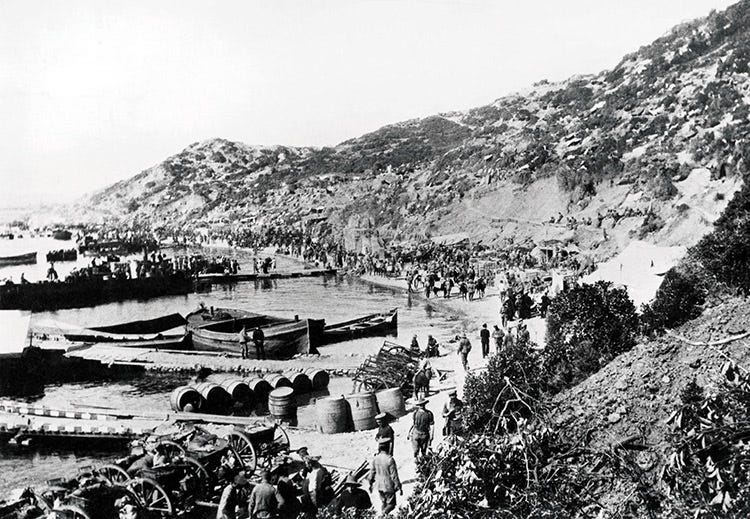
Indeed, while bad intelligence and worse charts are often blamed for the bloody imbroglio that followed the landings, from atop the hills, serene today, one sees few places along the coast where the defenders wouldn’t have had the advantage or the morning its terrible, crimson hue. We should never have been there.
It’s remarkable that the Allies got as far as they eventually did, and one may be forgiven for noting the stirring of a certain something in one’s chest when one considers that point. But it is the outrage of the internationalist more than the pride of the patriot that is ultimately stirred most deeply here. Every rocky cliff face, every impossible climb, every headstone in every cemetery—Ottoman as well as Allied—speaks silently to the point that every soldier on the ground, whether ordered over the top or, in the case of the Ottoman 57th Infantry Regiment, ordered, explicitly, to die, was ultimately seen by his respective empire as expendable.
This is something you don’t necessarily pick up in the dim light of a dawn service and something you don’t pick up at all in the dimmer light still of a public conversation designed, not merely to elevate Gallipoli above politics and debate, but to render war and national security untouchable as well. It is less ironic than inevitable that the Gallipoli campaign should have been hijacked over the past two decades by militarists and monarchists. The true lessons of the campaign are entirely at odds with those that such people wish to impart—let alone with the adventures they wish to take us on still—and it is thus necessary for them to employ rhetorical strategies that distract from what should be plain. Those who forget history are doomed to repeat it, while those who rewrite it merely doom others to.
We moved on from the ANZAC cemeteries, the most affecting of which was at Ari Burnu, the promontory at the north end of ANZAC Cove, which is home to the monument that immortalises Atatürk’s famous 1934 speech to the first Australians, New Zealanders and British to return to the battlefields after the war.
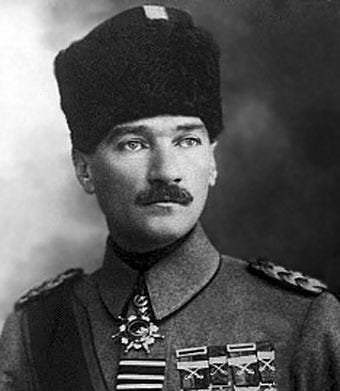
“There is no difference between the Johnnies and the Mehmets to us where they lie side by side here in this country of ours,” he said. “After having lost their lives on this land they have become our sons as well.”
From there we headed to the Ottoman memorial where the aforementioned 57th Infantry Regiment is honoured, every member of it either killed or wounded, the number fifty-seven later retired out of respect. The site is as inherently moving as any other on the peninsula, or at least it is for anyone with even the slightest capacity for empathy. Nationalism tends to preclude all but the most flippant recognition that an Australian grunt is no better or worse than an Ottoman grunt—the latter’s graves on a slight incline towards Mecca—while internationalism demands that we see past the false dichotomy to the fact that the two ultimately have more in common with each other than they do with the men ordering them to fire.
This was certainly true for the men of the 57th. If any of the countries involved in the conflagration has a right to trot out the baptism-by-fire, birth-of-a-nation-type stuff, Turkey obviously has a greater claim than Australia ever will. In addition to losing more soldiers on the peninsula than any other country involved—between 56,000 and 68,000 dead—it also kick-started the meteoric career of the founder of its modern, secular incarnation in the process. Never mind that Atatürk, however eloquent his later speech, was also the one who ordered the regiment’s members—Mehmet or otherwise—not to fight, but to die. No side in the war had a monopoly on suffering, and none of the countries that suffered a monopoly on myths.
We took the bus back to Istanbul in relative silence, having felt that we experienced the peninsula more fully for having seen it at a time when the fog of war nostalgia was at its thinnest and the landscape better able as a result to declare itself for what it was: not a baptismal font, just another of those countless places in the world where old men once threw young men at each other to die in the service of empires that had little regard for them. The city appeared to us as a glow on the horizon long before we could actually see it. Lest we forget? Sometimes it feels like we’ve already forgotten.
As you know, I dislike cannibalising my archives. I’d rather you get to read something new, like my forthcoming piece about the Jaipur Literature Festival. Hence, when I stoop, I stoop low enough to grab two. I published ‘Poppies for the forgotten: Armistice Day, imperialism, and the war that never ended’, which turns out to be rather relevant giving yesterday’s grotesque heckling, on Medium in November 2018.
Well, that went quickly, didn’t it? Today, on the eleventh hour of the eleventh day and all that, we marked a hundred years since the guns fell silent on the battlefields of WWI. This year, for obvious reasons, the commemorations took on an especially resonant tone.
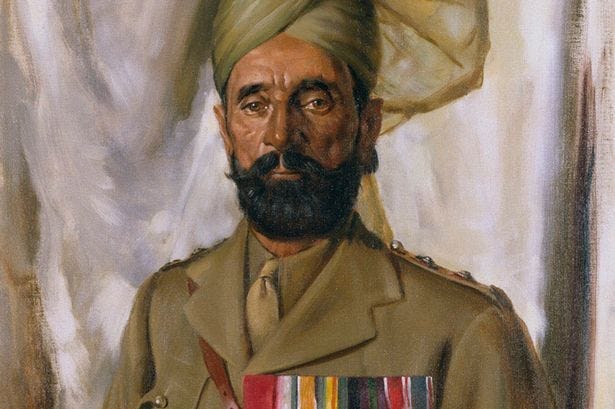
They did so for some less obvious reasons as well. In the lead-up to today’s events, one group, British Future, spearheaded the ‘Remember Together’ project, which aimed to increase awareness of the role that people of different backgrounds played in the Allied war effort. “The armies of 1914-18 looked more like the Britain of 2018 than that of its day,” the initiative’s website reads. “British troops fought alongside soldiers of different colours and creeds from across the Commonwealth, including over a million Indian soldiers, 400,000 of them Muslims from present-day Pakistan.” This latter group included Khudadad Khan, a Muslim who was the first Indian soldier to be awarded the Victoria Cross.
As the director of British Future, Sunder Katwala, told The Guardian last month: “We have seen extremists, both Anjem Choudary [who was convicted in 2016 for encouraging his followers to support ISIS] and Britain First, try to turn our cherished symbols of Remembrance into ammunition in their culture war. Both rely on an ignorance of our shared history when they tell Muslims and other minorities that they have no place in Britain.” In a separate initiative, the Royal British Legion produced 40,000 “khadi” poppies, made from the same linen worn by Gandhi, to honour the 74,000 Indian soldiers who lost their lives in the conflict.
Initiatives like these were welcomed by war-buffs, historians, and civil and religious leaders, both in India and in the UK. But it remains true that any proper accounting of the Allied war effort must also take into account the discrimination faced by many of the Commonwealth troops.
Members of Delhi’s Raqs Media Collective are currently in Colchester, where they have launched a new piece, ‘Not Yet at Ease’, to mark the centenary of the war’s end. In September, they made headlines in Britain after telling the Observer that they had uncovered evidence of systemic racism towards Indian soldiers with post-traumatic stress disorder.
“Our discoveries were made in the archives of the India Office Records, which are currently housed in the British Library, and in some archival material in the Imperial War Museum and in a sound archive in the Humboldt Museum in Berlin,” Raqs’ Shuddhabrata Senguta told me by email. He said the documents proved that the British deliberately and consistently neglected to treat psychological problems among Indian soldiers. He went one further, too, and added that there was a class element to this discrimination, in addition to a racial one.
“The British Officer classes had a form of class-hatred towards working-class British soldiers that needs to be reflected upon as much as their clear sense of racial superiority vis-à-vis the Indian soldiers, whom they continued to treat as alien and infantile, and refused to take into account as grown men with actual feelings and intelligence,” Senguta said. “The fact that Indian soldiers were suffering from undiagnosed shell shock is as significant as the fact that ordinary British soldiers were also undiagnosed.”
He described ‘Together Again’ as “too little, too late,” and noted that, in India, WWI remains a point of contention. “Although [the Indian troops] were not conscripts, like all soldiers in virtually every war they were compelled, cajoled, and coerced to fight to defend the interests of ruling powers that had nothing to do with their own well-being,” he said. “The memory of WWI and Armistice Day in India falls between the cracks of the empire’s amnesia about the people from the Indian subcontinent who fought in the war, and Indian nationalism’s unwillingness to take seriously the hundreds of thousands of people who experienced a reality that it cannot process.” According to the Indian historian Mridula Mukherjee, who spoke to the online publication Dawn four years ago: “You can’t call it sacrifice. It was surely not patriotism that made [the Indian soldiers] fight. It was mostly them looking for employment.” (Mukherjee didn’t get back to me when I emailed her.)
All of this is to say nothing of WWII, during which Churchill essentially engineered the 1943 Bengal famine, diverting food from India to the European theatre.
“I hate Indians,” Churchill told the Secretary of State for India, Leopold Amery, at the time. “They are a beastly people with a beastly religion.” Contacted by Delhi about the unfolding crisis, Churchill responded by asking why Gandhi wasn’t dead yet. (Recall why, in The Crown, Churchill—perfectly portrayed, against odds, by John Lithgow, his performance relying more on the vibe than on strict imitation or caricature—distrusts Matt Smith’s Doctor Who: because Louis “Dickie” Mountbatten, Philip’s uncle, is “the man who gave away India”. Like he had a choice at that point.) Roughly three million “beastly people” died in the famine.
The Australian context is slightly different, though we continue to speak about WWI as though it made us who we are. (Curtin telling Churchill to go jump, with WWII in full and bloody swing in Asia, strikes me as much more relevant to the myths we’ve made up about our national character.) It isn’t only that Churchill’s Dardanelles campaign wasn’t worth the paper it was planned on, as any non-chest-beating visit to Gallipoli attests. It isn’t only that the campaign in question should be considered less a baptism of fire than a sobering reminder that we follow our imperial patrons into places like Turkey, Vietnam, and Iraq, at our peril. It is the fact that there hasn’t been a proper reckoning of the discrimination meted out by our own army a century ago.
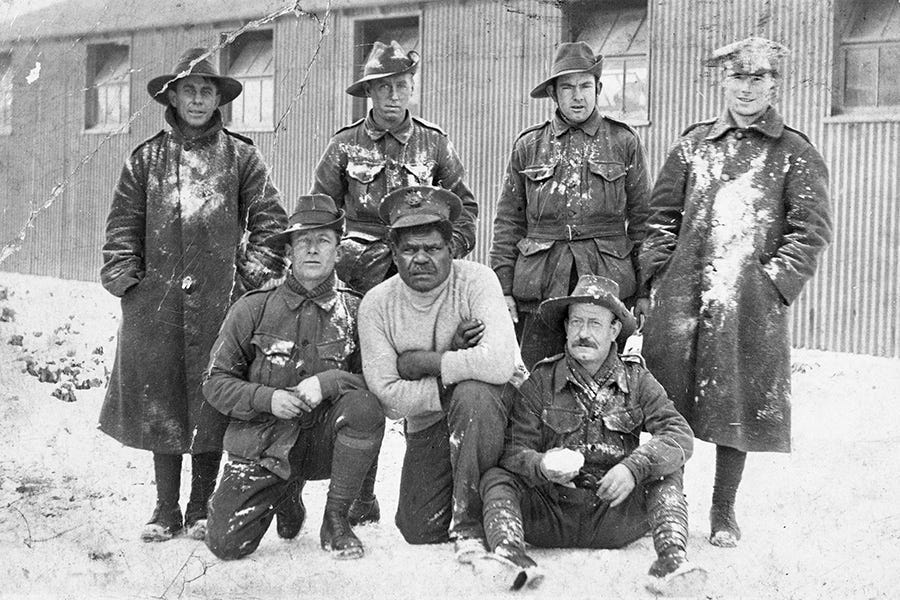
In 1916, Australian officers in charge of enlistment were told that “Aboriginals, half-castes, or men with Asiatic blood are not to be enlisted”. (In 1917, as white recruits became harder to come by, these restrictions were partially lifted. “Half-castes may be enlisted in the Australian Imperial Force provided that the examining Medical Officers are satisfied that one of the parents is of European origin,” a new set of orders read.) Roughly a thousand Indigenous Australians wound wind up serving in the war. According to the Australian War Memorial website—it must be acknowledged that there has been at least some attempt to recognise these veterans at the official level—“upon their return to civilian life [the Aboriginal soldiers] were treated with the same prejudice and discrimination as before.” Well, blow me over with a feather.
Obviously, we have a civil duty to remember that the war was fought in large part by Britain’s imperial and colonial subjects. There’s something nice and inclusive about it, especially given our current obsession with identity politics. (That Senguta felt the need to bring up class in our email conversation struck me as refreshingly old-fashioned.) But there are other important reasons to do so, too. By remembering the imperial make-up of the Allied side, we are also forced to remember, despite ourselves, that the war was fought for imperialism’s sake.
This realisation forces us in turn to zoom out from the European theatre—to pan sideways and take in the world at large—and recall the effects of the war elsewhere, and indeed those of the Armistice that followed it. Because whatever I may have said in my opening sentence, the guns never really fell silent at all. The Great War, the War to End All Wars, never properly ended anything. The most salient result of the Armistice, and of the uneasy “peace” that attended it, was ultimately more violence. Think of the 1916 Sykes-Picot Agreement, the legacy of which we are dealing with throughout the Middle East today, or of the effects of WWII, which was a direct and predictable consequence of Versailles. Think of the Cold War, which followed the second cataclysm, not only along the Iron Curtain, but in Southeast Asia, in India, and in Africa. Most if not all of the conflicts that continue to trouble policy-makers today have their roots, directly or indirectly, in an almost-botched assassination on the streets of Sarajevo in 1914. Senguta described ‘Not Yet at Ease’ like this: “It’s an immersion installation that uses wall murals, architecture, sound and video, and interpreted archival material, to create conditions for thinking about the fact that, in our view, WWI never ended”
Well, quite. The aforementioned assassination not only gave birth to the greatest open-plan slaughterhouse mankind had ever seen, but also resulted in the Russian Revolution, the carving up of the Middle East, the later collapse, in the aftermath of WWII, of the European colonial project (a good thing, though not without its own repercussions), and everything that followed. Even September 11, 2001, which some commentators like to consider the proper end of last century, had its roots in Sykes-Picot, the rise of the Soviet Union, and other post-Versailles realities. We are still living in a post-Versailles world.
You can wear a poppy if you like—I love wearing poppies!—including the khadi one, if you can get your hands on it. But without a serious discussion of how the war continues to plague us, and the reasons we fought it in the first place, we will be forever condemned to keep making the same mistakes. Reckoning with how we treated our own side seems to me like a good place to start.