
Eerily close, the dead
Notes on Shimla, Delhi, Bondi, and Joyce

I arrived back in the mountains on Saturday, fully packed and prepared for a white Christmas. Unfortunately, snow seems very unlikely. Himachal Pradesh, it turns out, is recording one of its driest Decembers on record, with large tracts of the state receiving no measurable rain or snowfall at all. On the day I arrived, Shimla, the one-time summer capital of the British Raj, was a balmy nineteen degrees. By the time I had walked out to the former Viceregal Lodge, I was sweating almost must as much as I had been after trekking to Kheerganga a month ago.
Getting to Shimla was something of a nightmare. I was once again reminded why, in the main, planning anything here is pointless. After a wonderful final evening in Delhi with Sam Dalrymple and some of his friends—an eclectic line-up of writers, filmmakers, and other gadabouts—I arrived at the railway station at six in the morning, only to learn that my train to Kalka had been delayed by several hours. I had been hoping to take the famed Himalayan Queen from Kalka into the hills, and in order to make my connection there ordered an expensive inter-city Uber. We arrived fifteen minutes too late. As a result, I hired another car to take me the remainder of the way, only to get lost, several times, in the winding roads leading into the city, a system that to my mind suggested five or six rollercoasters built haphazardly on top of one another. I went to bed almost as soon as I checked in.
Getting to Shimla has never been easy. In his short story ‘The Other Man’, collected in Plain Tales from the Hills, Rudyard Kipling describes a particularly miserable journey:
Sitting back on the back seat, very square and firm, with one hand on the awning stanchion and the wet pouring off his hat and moustache, was the Other Man—dead. The sixty-mile uphill jolt had been too much for his valve, I suppose. The tonga driver said, “This Sahib died two stages out of Solon. Therefore, I tied him with a rope, lest he should fall out by the way, and so came to Simla. Will the Sahib give me bukshish? It,” pointing to the Other Man, “should have given one rupee.”
I paid several thousand times more than that, but at least I made it up here alive.
Shimla has historically been a walker’s city. In Kipling’s day, military men and their wives, or someone else’s, would promenade along The Ridge each evening, strolling down to Scandal Point, from which the Maharaja of Patiala, Bhupinder Singh, is said to have eloped with the daughter of a British Viceroy, giving the spot its name. Even today, Mall Road remains packed, especially at the moment, in the lead up to the city’s Winter Carnival, which begins this evening. The Ridge, which sits at the top of town, has been in a state of furious preparation since my arrival, with food stalls and a central bandstand going up opposite the creamy-yellow Christ Church, which, in the evenings, has glittered with Christmas fairy lights.
Of course, it’s only a walker’s city to a point. It long ago burst its Raj-era levees and began cascading down the slopes into the valley. Even in the old days, you really needed a horse to get around. Now, you need to stay near one of the town’s lifts, or else a road that isn’t closed to traffic, if you wish to go anywhere that requires even the slightest change in your overall elevation. (The Jakhu Ropeway, which takes you to the temple at the top of Jakhu Hill, is an enjoyable alternative to these options, though the temple is lousy with Rhesus macaques and hulking great Hanuman langurs, neither of which know fear and thus, in me, have a tendency to inspire it.) The alternative is to trek up and down the city’s slopes, some gentle, others vertiginous. If you make the same mistake that I did, and wind up in a hotel that’s unreachable except by means of a flight of near-vertical stone steps, you’d better have strong calf and thigh muscles. I have neither.
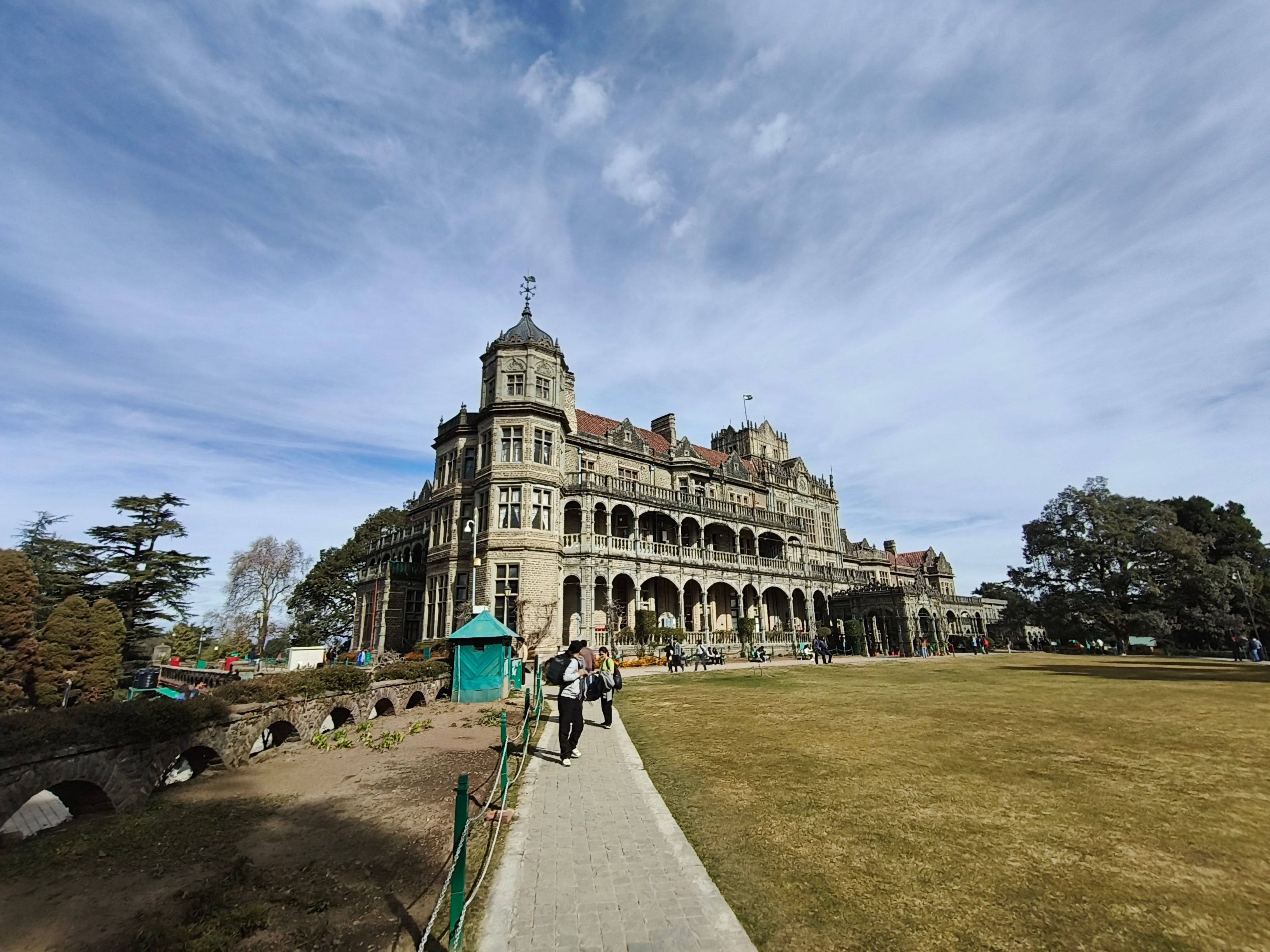
I was nevertheless glad that I walked out to the Viceregal Lodge, today known as the Rashtrapati Niwas and home to the Indian Institute of Advanced Study, on my first morning in town. Perched atop Observatory Hill, an hour’s walk from The Ridge, the building is a grand, self-consciously imperial affair, built of grey stone in the Jacobethan style, the sort of pompous and imposing thing one erects to imply that one’s rule is forever. The interior, with its impressive wooden panelling and pilasters, hewn from teak, cedar, and walnut, is equally grave.
But what really brings one here is the history: the Lodge was the site of both the 1945 Simla Conference, which Lord Wavell convened “to ease the present political situation and to advance India towards her goal of full self-government,” and the 1946 Cabinet Mission conference, which sought to do much the same thing. Neither conference was a success, all but ensuring the horrors of Partition. Besides the remarkable photographic history of that time, which lines the walls today—photos of a prim, very serious-looking Nehru, the towering figure of Khan Abdul Ghaffar Khan, the clean-shaven, cigar-puffing Jinnah in his perfectly-tailored suits, and Gandhi, who was in town for the 1945 conference but not a participant in it—what really takes your breath away is to be told that it was at this small, round, entirely unprepossessing table that British India was, in the end, torn asunder.
Delhi is even less of a pedestrian city than Shimla, though that didn’t stop me, stupidly, from treating it like one, especially when I arrived in India in November.
It’s not that there aren’t parts of Delhi—a city I still don’t know very well, but that I am at least beginning to get a minor handle on—that can’t be walked in something like comfort. The Lodhi Gardens are a stroller’s paradise. The alleyways of Old Delhi have been made to be explored on foot. Chandni Chowk is literally a pedestrian street for twelve hours a day and Khan Market is a small bubble of money around which one can do laps to get one’s steps in. The problem is getting between these places, traversing the liminal and non-spaces of the city, which, being an idiot, I also largely did on foot. I have spent a lot of time lurking around beneath underpasses.
It’s not as though the locals don’t do it. While I don’t go as far as those who jump bollards on the Grand Trunk Road—mad props to the Muslim women in full veil I saw pulling that off a couple of weeks ago—I have joined the huddled masses trying to cross it at more sensible places.
I learned how to cross Asian roads in Saigon, where the rule is to look straight ahead and let the traffic swarm around you. That will get you killed in Delhi. In Delhi, you really need to be a cow—it would be a major faux pas for a driver to hit you—or at least to have the panoramic vision of one. There is a trick to determining, within a split second or so, which wall of bikes and autos and trucks and buses is your most immediate threat, and another to walking into and navigating that threat while fleetingly checking other oncoming walls.
The real problem, though, and the real physical risk to one’s health as a pedestrian in Delhi, is the air. A fifteen-kilometre walk through Delhi, which is not an uncommon undertaking for me, is akin to a two-pack-a-day habit at the moment. Over the past two months, Delhi’s Air Quality Index (AQI) repeatedly deteriorated into the “very poor” to “severe” range. Next to nothing has been done about it—except, for example, to ban coal- and wood-fired tandoors, as though the city’s chicken and roti consumption were to blame—and in general the approach to the problem has been to downplay or deny the extent of it. Earlier this month, the government said that the World Health Organisation’s air quality guidelines weren’t binding, and claimed that its own are sufficient, which they aren’t. A few days later, it claimed there was no data proving a direct correlation between AQI levels and lung-related illnesses or deaths. (In fact, according to the Air Quality Life Index at the Energy Policy Institute at the University of Chicago, air pollution is shortening the life expectancy of Delhi residents by about twelve years. Another study, by the Institute for Health Metrics and Evaluation, found that one in seven deaths in Delhi in 2023 was linked to air pollution.) A planned debate on the crisis in parliament, which had been scheduled to take place before it wrapped up its winter session on Friday, was scrapped because of the “bad atmosphere” between the parties.
The bad atmosphere, you say? You couldn’t make it up.
One morning a couple of weeks ago, I went out to the ruins of the former Tughlaq citadel, the Feroz Shah Kotla, which was built around 1354. The visibility on the roads was nil: everyone was relying exclusively on their horns and on the brake lights of the vehicle in front of them. I wasn’t wearing a mask and should have been. You could have cut the atmosphere like cake.
Unlike some other sights I have visited on this trip, addressing a number of long-standing blindspots—the Taj Mahal, Agra Fort, Tughlaqabad Fort, Nizamuddin, and others—the citadel was completely deserted but for a few young couples, shying away from prying eyes. The dead, I thought, felt very close, however properly ruined these ruins were.
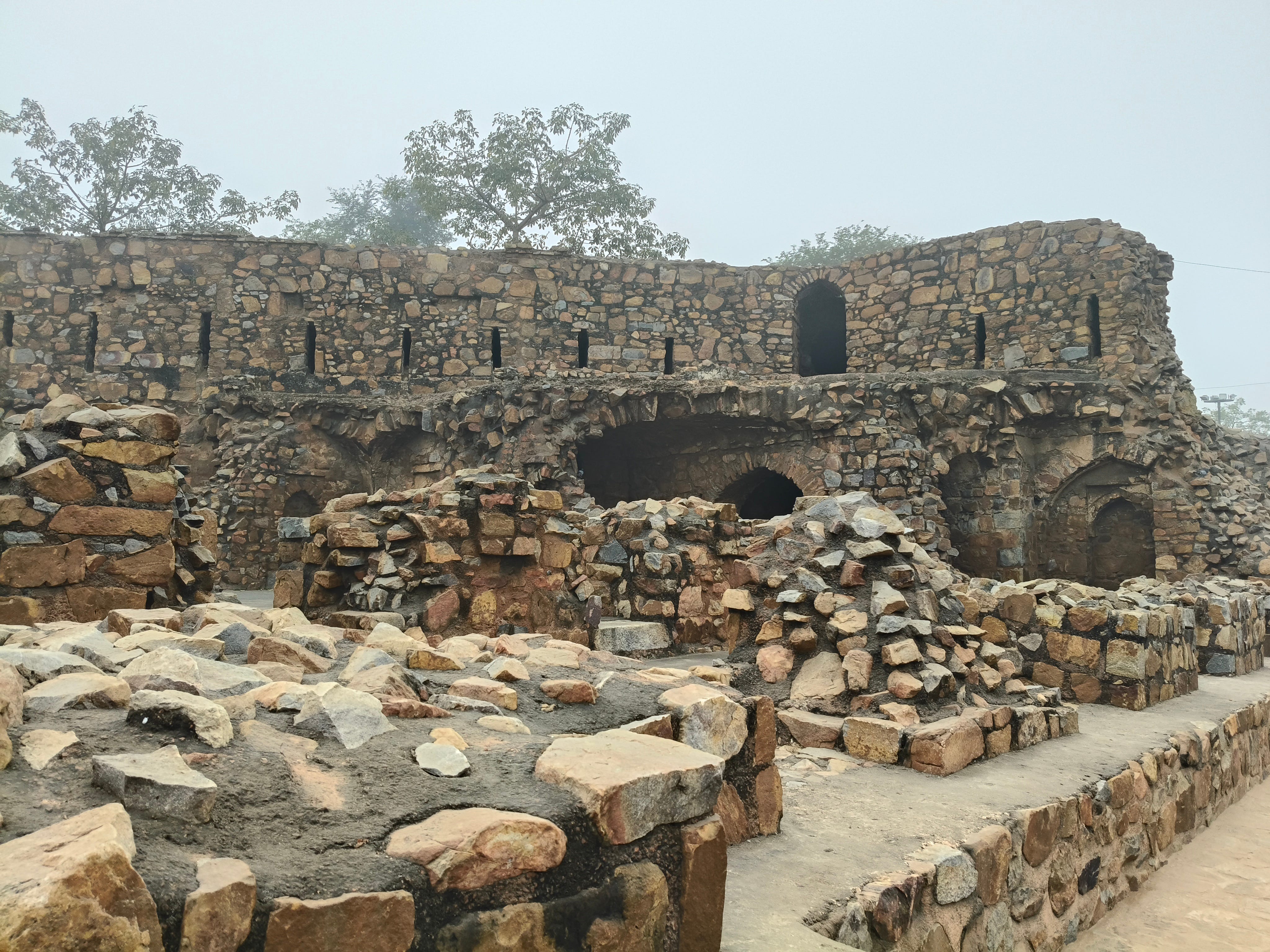
I rather suspect that the air had something to do with it. It certainly added to the ghostliness of the place. Aside from the clandestine lovers, the only figures I could make out amongst the centuries-old granite belonged to women whom, I assume because it’s an easy way of generating employment for people, walked about the lawns, not raking them, but sweeping them with brooms. They did so in utter silence. The citadel’s mosque, which was apparently the model for one that Timur later had built in Samarkand, is in ruins, too, but despite this remains in use today—a little sign beside the mihrab advertised the daily prayer times—nearly seven hundred years after it was built and six hundred after the Tughlaqs fell.
In City of Djinns, Dalrymple refers to Delhi as “a city whose different ages lay suspended side by side as in aspic,” which is in some cases literally true. Later that morning, I walked from the Feroz Shah Kotla to the Purana Quila, a mere three kilometres down the road but two whole centuries along in the city’s history. For the moment, though, I merely stood in the silence and listened out for ghosts.
One appeared, or for a moment seemed to. But it turned out that the man was alive. He entered the mosque’s courtyard and sat close to the mihrab. I don’t know whether he was praying or merely visiting.
So eerily close, I thought again. So eerily close, the dead.
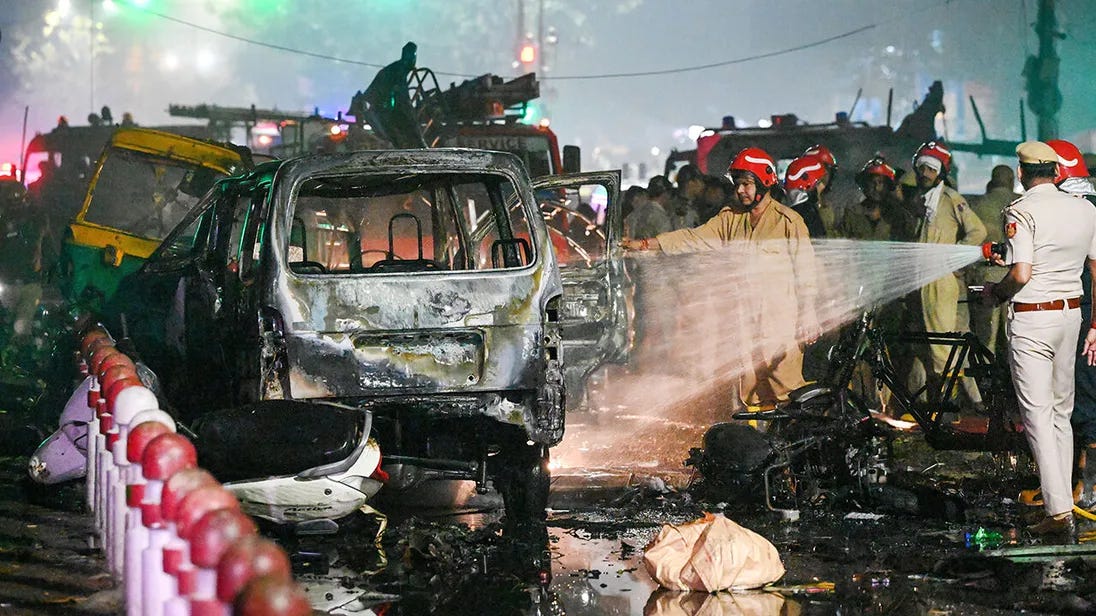
If treating Delhi as a pedestrian city is physically dangerous in more ways than one, it proved especially dangerous three days after I left in November, when a car bomb went off outside the Red Fort in Old Delhi, a ten-minute walk from where I was staying near Kashmere Gate. At least fifteen people were killed and more than twenty injured.
The bombing was immediately politicised. Within hours, the usual suspects were framing the attack to suit their pre-existing narratives, hurling accusations at one another and opportunistically assigning blame. The attack became less an event to be understood, or even a crime to be solved, than a weapon to be wielded.
This is nothing new in India. In the wake of the 2019 Pulwama attack, which I wrote about in an updated introduction to my 2018 Kashmir series when The Daily Beast republished it in response to events, “[t]he Indian media, up to and including ostensibly liberal journalists like Barkha Dutt, devolved […] into an unthinking, bloodthirsty rabble. Bollywood actors, who have only ever played at war, became all-too-willing mongers for it.” Despite the fact that the attacker was from Indian-administered Kashmir—as was the suspect in November’s car bombing—the Modi government blamed Pakistan for harbouring terrorists and, for the first time since 1971, the two countries engaged in dogfights over the Line of Control. For whatever reason, the government was less willing to directly blame Islamabad in the wake of the November bombing, perhaps because, this time around, there wasn’t an election on the line. In 2019, some members of the BJP actually wondered aloud in the press how many seats their brief war might net them at the ballot box.
The attack in Bondi a little over a week ago killed fifteen people, too, and left more than forty injured. The emotional response, the shock and grief, is more than understandable, not least because Australia isn’t really used to such things. Our last real terror attack was the Lindt Café siege more than a decade ago. Our last mass shooting took place in Port Arthur in 1996, and led to such remarkably successful gun law reforms that, not only did we convince ourselves that something like this could never happen in Australia again, we actively lorded it over the US—correctly—whenever it happened there. There is also a justifiable sense of shame at the idea that, as my friend Jack noted in his heartfelt dispatch from Bondi last weekend, the single largest attack on Jews since October 7 should have taken place on Australian soil.
And not only on Australian soil. Indeed, I suspect the psychic wound is all the deeper for having been inflicted in Bondi, which is as iconic, to many Australians, as the bridge, the Opera House, or the rock. (Not to me, though. I don’t have much time for Bondi, which embodies, in a single suburb, a lot of what is most grotesque about Sydney. But that’s obviously an argument for another day.) Whether iconographic significance was part of the attackers’ plans, or simply unhappy coincidence, I have no idea, but there’s no getting around the fact that the idea of the beach in general, and of this beach in particular, carries a lot of symbolic weight in Australia, both positive and negative. (Let’s not forget that Australia’s most notorious modern race riots were also a seaside affair.) It will be interesting to see how Bondi bounces back, and how long that takes. I have been to Ground Zero, both when it was a crater and since, as well as to Port Arthur, and even now, so many years later, these places have an unsettling quality about them that they seem unlikely to ever fully shake. Eerily close, even now.
The cross-cultural, multi-faith vigils and gatherings that have taken place since the shooting are obviously an argument in favour of hope. Almost everything else that has happened, though, has been an argument against it. What happened in India a month ago has happened, on steroids, back home. The Liberal Party, the political wing of the Murdoch media empire, has taken the shooting as an opportunity to wheel out its immigration policies from a quarter of a century ago. (I thought it telling that, prior to his outing as a Syrian Muslim, the hero of Bondi, Ahmed al-Ahmed, was widely reported as being a Maronite Christian.) The pro-Israel lobby, which never saw a horror it didn’t try to either exploit or erase, depending on the faith of the deceased, has doubled down on its absurd claims that anti-Zionism and antisemitism are one and the same thing. (Some of Australia’s most outspoken anti-Zionists, like my friends Antony Loewenstein, Na’ama Carlin, and Claire Wright are Jewish.) Any attempt to inject context into the debate—such as by observing the ideological character of the Hannukah event that was the target of the shooting, as Guy Rundle has done in daring to breath the word “Chabad”—is to be condemned as antisemitic. (If the Muslim Brotherhood were to hold an iftar event at, say, Bronte, people would lose their goddamned minds.)
The Labor Party, always keen to be squarely framed by the Overton window even as its opponents pull the thing ever further to the right, has unfortunately bought into the most transparently fallacious and silly reading of the shooting: that a man and his son were inspired by peaceful marches in Australian cities, and by university students spouting platitudinous slogans, to join the Islamic State and carry out mass murder. As a result, the government has said it will adopt the draconian, entirely pro-Israel recommendations of the Special Envoy to Combat Antisemitism, Jillian Segal, which would make it a hate crime for me to write and publish a piece like this one. I was deeply troubled by photos from the day after the shooting, which showed mourners at Bondi draped, not in the Australian flag, but the Israeli one. But it would only be a couple of days before the Labor Party was effectively draping its policies in the same. If the first group needs better symbols, then the second needs stronger backbones.
Unsurprisingly, the one group that seems to have behaved with any decency or decorum, besides that noble segment of the Jewish community that has explicitly asked that its grief not be politicised, is the pro-Palestinian movement, perhaps because it has some familiarity with wanton slaughter and the pain that attends it. While many Zionists decided to sit out sitting shiva in order to get to work ensuring that Australian and Israeli policy be made to have as little sunlight between them as possible, most anti-Zionists of my acquaintance expressed nothing but grief, and then mostly in private, until it became obvious what was coming down the pike at us, at which point defending freedom of speech became something of a necessity, not to mention a matter of self-preservation.
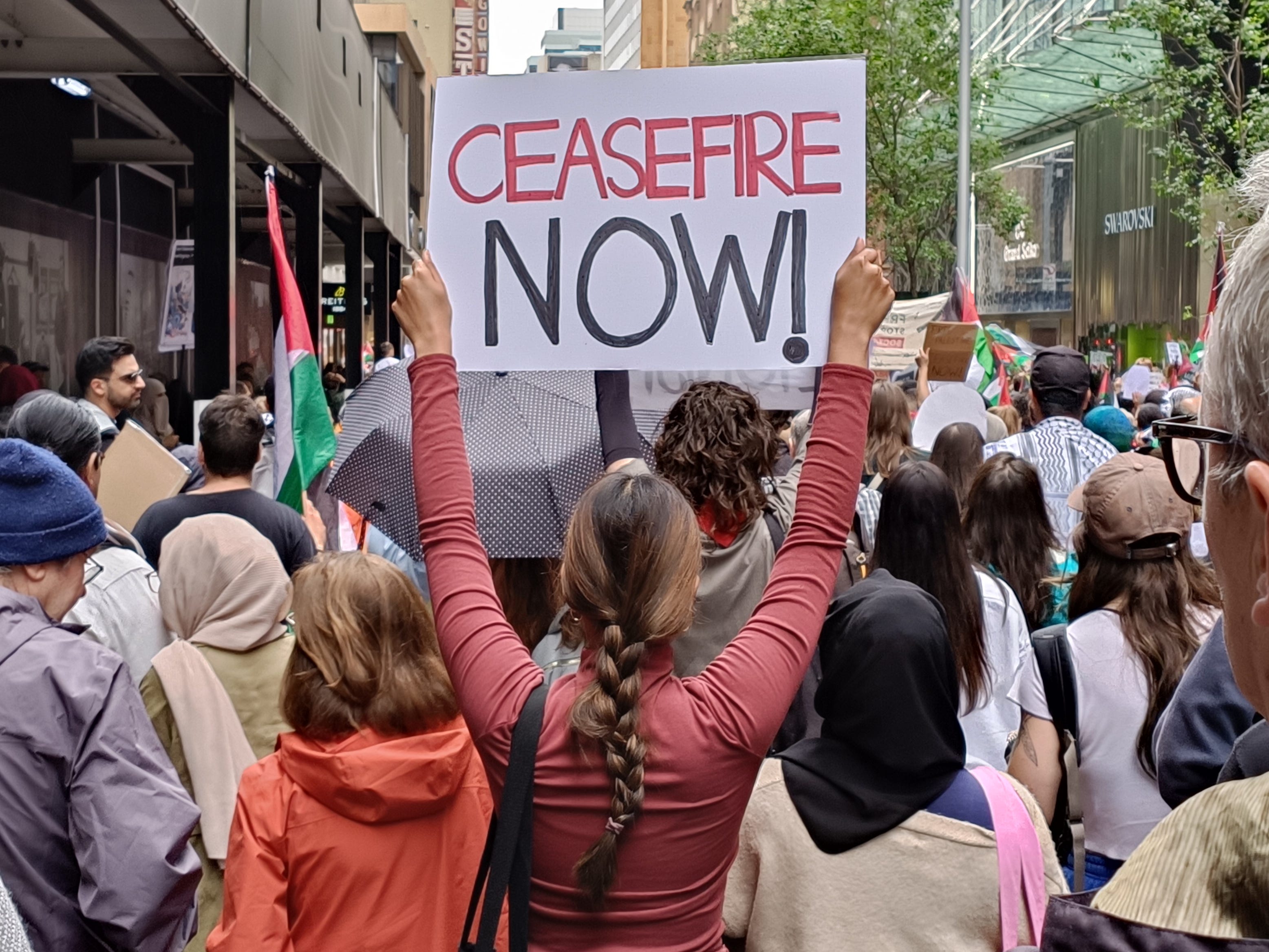
I have attended some of the pro-Palestine marches that have taken place over the past two years. I didn’t cross the bridge, because it was raining and I am lazy, but I can safely say, from my experience of such events, that no one in attendance was there for reasons of Jew-hatred. A lot of them were Jewish themselves. Even more were Aboriginal Australians, perhaps the single greatest example we have on our continent of a group that understands the meaning of the word “solidarity”. The vast majority of Muslim Australians were there with their kids. No one wanted to see Jewish children shot up. They wanted Palestinian children to stop getting shot up. These are the people who are now being accused of inspiring and encouraging terrorism.
Any crackdown against freedom of speech or assembly will almost certainly go ignored. It seems pretty obvious that people are going to keep saying what they’ve been saying since the genocide began—namely, that it should end—and that eventually the government will learn that it cannot imprison or fine everyone who does so. Even if it tries to, which it won’t, what it and the pro-Israel lobby are likely to find is that marches and placards and university students weren’t the problem in the first place. When the next large-scale horror comes, in the absence of these things, which it will, they may be forced to reckon with the idea that the greatest threat to Jews worldwide, and the greatest driver of antisemitic feeling, is not Aboriginal solidarity, or a young Gender Studies student in a keffiyeh, but the actions of the Jewish state.
Since the Bondi shooting on December 14, at least fifteen people have been killed in Gaza, including a baby who was among those murdered when Israeli forces struck a school that was housing displaced people. This brings the number of Palestinian casualties since the ceasefire went into effect in October to somewhere around four hundred.
Five or so years ago, in the wake of a break-up, I started listening to the History of Literature podcast. It was a comfort to me during a difficult time, to hear about Jane Austen and F. Scott Fitzgerald, and I think I wound up listening to something like two hundred episodes in a row, in chronological order. It became a little less interesting to me the longer it went on, especially once its format changed, and I nearly gave up entirely when they finally covered an Australian author and it was—Patrick White? Christina Stead? Gerald Murnane? Shirley Hazzard?—no, Pip Williams, author of The Dictionary of Lost Words. As far as literary podcasts go, I spend most of my time with The Secret Life of Books these days. I like the cut of their jib.
But I have taken to adopting one of the former podcast’s traditions: the reading, preferably aloud, of James Joyce’s ‘The Dead’ on Christmas Eve. (The idea is actually to read a story from Dubliners every day in the lead-up to Christmas Eve, culminating in ‘The Dead’, though I’ve never tried it.)

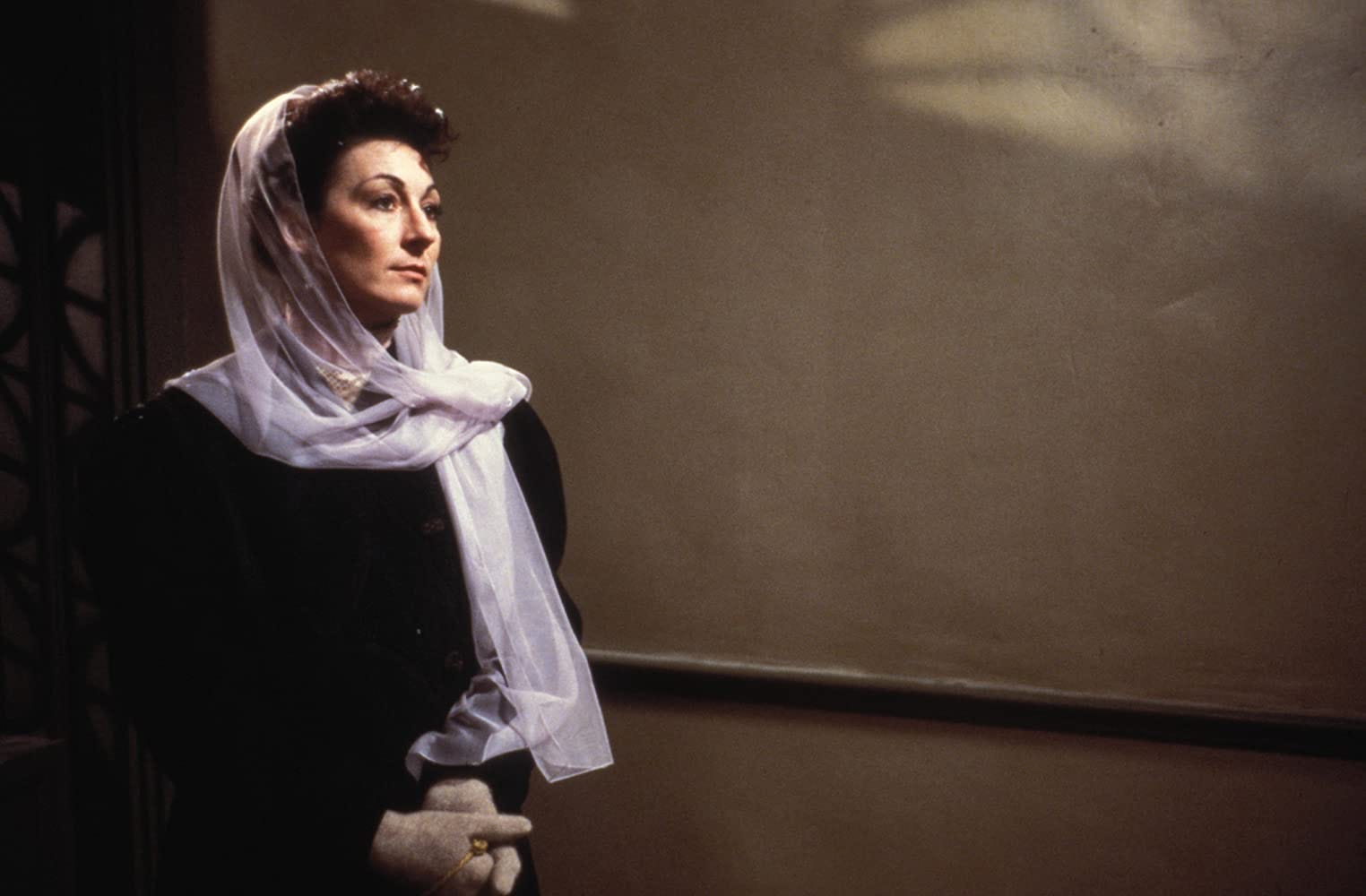
In a couple of hours, I will be heading off to Wildflower Hall, originally the site of Lord Kitchener’s summer home, to attend a Christmas Eve dinner for which I am paying too much money. But before I do so—as soon as I publish this piece, actually—I will be sitting down with the story again. It is the only tradition I will be keeping this year, so far from home—and it not even snowing—and thinking of my family. A little something to keep me tethered. I suggest you read it, too, or have it read to you, or perhaps even watch John Huston’s film version.
His soul swooned slowly as he heard the snow falling faintly through the universe and faintly falling, like the descent of their last end, upon all the living and the dead.
Loved this. So much reminds me of my time in India. A fascinating, frustrating, infinite place
Are you tracing the steps of the empire in India? Fascinating. An era now totally ignored. Must be feeling many ghosts! I’m only halfway through the essay.